Abdurasul Zharmenov, Soviet and Kazakh metallurgist, twice winner of the State Prize in science and technology, Doctor of Technical Sciences, Professor, Academician of the National Academy of Sciences of Kazakhstan, Director of the RSE "National Center for Integrated Processing of Mineral Raw Materials of the Republic of Kazakhstan":
At the age of 25 he became the "Inventor of the USSR"
Our reference:
Year of birth: The Monkey (1956)
Zodiac sign: Capricorn (January 11th)
Books: "The Way of Abai" by M. Auezov, "Christmas Shoes" by Donna Vanleer
Poet: Ulykbek Esdaulet
Singers: Tamara Asar, Kanat Umbetov, Aliya Abiken, Dimash Kudaibergen
Actors: Doskhan Zholzhaksynov, Asanali Ashimov
Dish: meat
Drink: cognac, whiskey
Life principle: be honest
SINCE CHILDHOOD HE SAID: "I WILL BE A PROFESSOR"
– Abdurasul agha, since our publication is mainly biographical, tell us about your native land and family?
– I was born in the village of Babaikorgan, Turkestan region. Our village is located 40 km from Turkestan. The inhabitants were engaged in cattle breeding and farming. But I've been spoiled since I was a kid. When I was born, my older brothers had already graduated from school and were adults. That's why I didn't do any cattle or household chores.
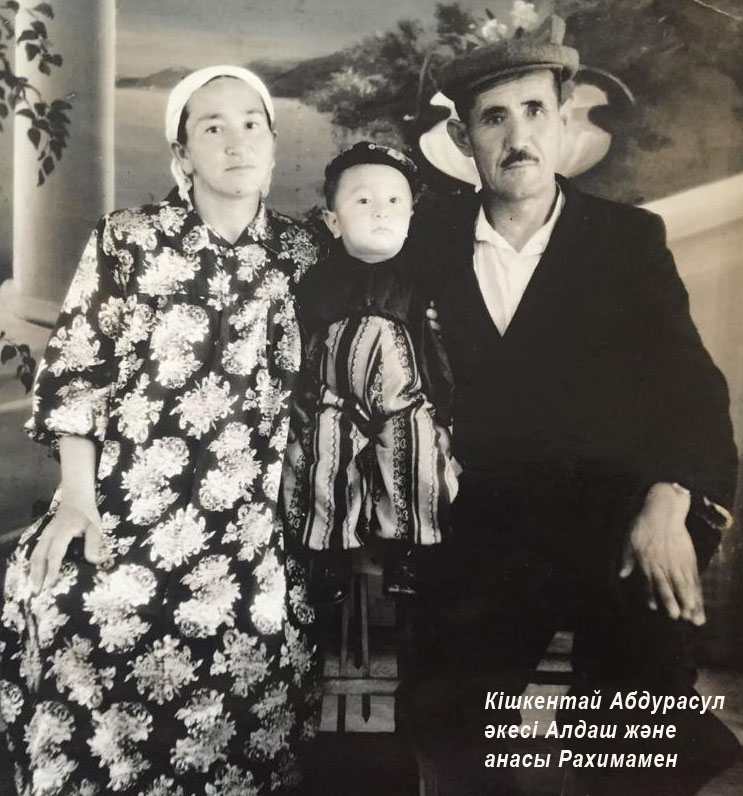
After the war, my father was chairman of a collective farm. But three months after that, he was arrested and sentenced to 15 years. That's how my father got caught up in Stalin's latest wave of repression. However, after Stalin's death in 1954, he was released from prison. 10 years after that, in 1956, after the birth of four sons, I was born. Only my sister was born after me. We had seven children, but one brother died at the age of two. His name was Beris.
That's how we grew up in a simple rural family. Electricity came to the village only in 1967, and a TV set in 1968. Before that, we used kerosene lamps. We burned the lamp all night and it turned black. In the morning, my mother cleaned it.– Did your father serve his full term in prison? Tell us about him.
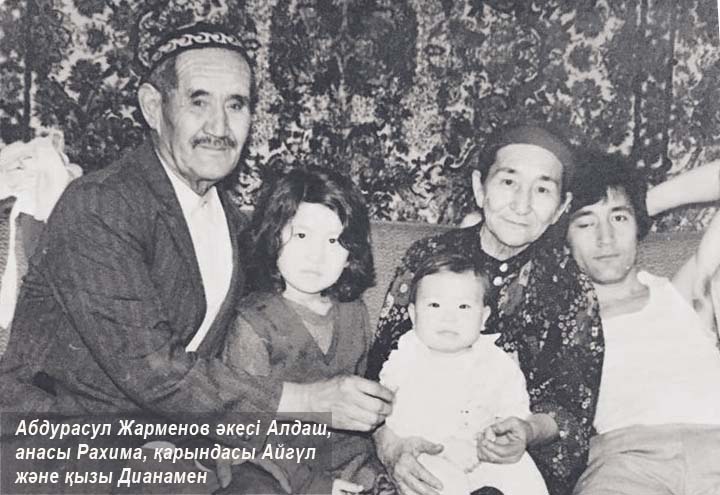
– No, he served 5-6 years. My father, Aldash, participated in the war. I only saw him when he was an adult. When I was born, he was 45 years old. My father worked as a cotton foreman. A very hardworking man. According to his mother, he worked tirelessly especially after prison. He was engaged in hard physical work, digging the earth, growing potatoes and turnips. He had never known fatigue. Although he had no higher education, he was very literate. He read the Koran and was religiously literate. He told us various religious stories.
– What story remains in your memory?
– One story remained in my memory. One day, a man told the prophet, "Whatever comes your way, try to swallow it." One day, a large hill stood in front of him. It was hard to swallow at first, but then it got easier, and eventually he swallowed this hill as well. Then he was asked: "Do you realize what you've swallowed?" He replied, "No, I don't understand." Then they said: "It's anger. Swallowing anger will be good for you and others."
My father also helped me with math and gave me logic problems. He taught me how to play chess.
– And your mother?
– My mother's name is Rahima. She was the eldest of five girls in the family. She was pregnant seven times. Mom was very dreamy. Before going to bed, she told the children: "My son and I went by car..." – making up stories, because there were no cars in the village then. Later, all her children grew up educated and spoke: "All your fairy tales have become reality." Mom lived with us and saw the achievements of the older children. But I didn't manage to do much for her. In 1991, I defended my doctoral thesis, and in January 1992, my mother died. She only saw my thesis and some achievements. However, in 1989-1990, when I was engaged in science, my mother was about 75 years old. Despite the wealth of the older children, no one gave her a gold jewelry, and I used my first significant income to buy a gold jewelry for my mother. We went to a jewelry store, and she chose something she liked. She was very happy because she loved beauty and style. Even at home, she changed her clothes two or three times every day and sewed her own clothes.
Mom was illiterate, but she really wanted to study. She paid great attention to the education of children. We all got higher education.
– When the father went to prison, the mother was left with four children. Was it hard for her?
– During the war, she worked as a kindergarten teacher. When my father went to prison, my mother stayed with four children and earned sewing. She not only sewed clothes, but also made dolls for sale.
– You mention the brothers. Tell us about them.
– My older brother, Kenesbek, was 20 years older than me. He graduated from journalism in Almaty. He wrote poetry and was a creative person. In his sophomore year, his parents called him home and arranged a marriage. At first, he worked for the district newspaper Kommunisticheskiy Trud, then moved into teaching and rose to the position of school director. When I was studying, he was the deputy director. He taught geography, Kazakh language and literature. I took all A's except geography, where he gave me a 4. He gave me special gifts for my birthdays, taught me photography and Arabic. Thanks to him, I developed a love of knowledge. Kenesbek died at the age of 70.
The next brother, Kelis, was handsome and looked after himself like a mother. He died this year in March. All his children are doing well, two are abroad – in America and England.
The third brother, named Kelis, was engaged in trade, died at the age of 59, left children.
The fourth brother is Zhambyl. We're 10 years apart. He worked in a taxi company, he was very kind, everyone came to us. My children called him "grandpa." He died at the age of 63.
Thanks to my brothers, I didn't worry about food and clothes when I was a student. They helped with everything necessary.
My sister Rosa was born after me. Now she lives in Astana, graduated from the Kazakh National Pedagogical University for Girls. She is married and has children.
– Were you a naughty boy among the brothers?
– I was spoiled, but not a scamp. I haven't tried alcohol until I was 30. When I was a student, my younger classmates saw me as a child and wouldn't let me drink.
– What about studying at school? From an early age, an interest in science?
– Studied well. I went to school at the age of 6. I didn't teach the third grade because there weren't enough places in the village. He mastered the third grade program on his own and graduated from high school at the age of 15. Since childhood, I dreamed of becoming a professor. At first, I skipped a little, but I studied hard from the sixth grade. All the scores were "five". The road to school was 3 km away, and I was mentally doing my homework along the way. Even now I remember the Kazakh cases by heart.
– And drawing and creativity...
– Did you have any hobbies?
– No, I couldn't draw at all. Even sketching was difficult for me. I didn't play musical instruments. But I had an interest in singing. At the table, among our family, I sang. He sang correctly, and if he lost his rhythm somewhere, he immediately noticed it. My children also have a penchant for music. Grandchildren are real talents.
– So, at the age of 15 you came to study in Almaty, right?
– In our village, near Shymkent, they thought: "If you don't have connections, you won't be able to study." My brother had a friend at the railway institute. I decided to apply there, but during the medical examination my eyes did not go away.
At that time, my mother's sister's two children were also enrolled in the city. The three of us were preparing at my brother's house. Then our aunt said, "If you go to the Drug Farm, you'll be accountants." When there were two or three days left before the surrender, Brother Kelis came and asked: "Where are you going?" I said, "To the Drug Farm." He got very angry and said, "Why do you need a drug farm? If you don't enroll this year, you'll enroll next year." He took me to the main building of KazGU and offered me to choose one of three subjects: chemistry, physics, and mathematics. I saw that most of the applicants were going to chemistry, and to keep up, I chose chemistry (laughs). My aunt took the documents from the Drug Farm and sent us to KazGU together.
The exams lasted three days. My aunt's children took the exam on the first day, her son on the second, and me on the third. We didn't have any books to prepare for, so we went to the exam unprepared. On the first day, my aunt's daughter got a "two", and on the second day, my son also got a "two". I thought: "If you don't have connections, you won't get in," and decided not to go. The next morning, my brother came, took me by the shoulder and led me into the classroom first. I passed the exam, told everything I had learned at school, but there were problems with calculations, since we did not solve them in the village. The teachers helped, and I did well, getting an "A". There was so much joy that I jumped from the stairs to the end and hugged my brother. After that, I realized that academic students are not knocked out of exams, they need educated students.
So I studied well, got a scholarship, and actively participated in lectures. I learned everything in lectures, I just rested at home. He graduated at the age of 20.
He was the first to study and apply the method of purification of metallurgy using membranes
– Student life is impossible without romance. Tell us about your first love.
– Of course, there was a first love. When Brother Zhambyl got married, his wife's sister, Zhanyl, was also a student, two years older than me. I fell in love, and so did she. We met for a long time, but we realized that we couldn't be relatives, and we didn't get together. We still maintain friendly relations. She now lives in Astana, her husband died last year.
– After graduation, what did you do? First job?
– What kind of institute was it?
is a chemical and metallurgical institute founded by Kanysh Satpayev. Previously, the director was E.Buketov. In 1977, on my birthday on January 11th, I got a job there. Entered like a grain, came out like a mountain. He worked for 16 years, and returned to Almaty in 1992. After defending my doctoral thesis, I joined the National Center for Integrated Processing of Mineral Raw Materials, where I am the first employee. I have been working here for 26 years.
Over the years, there have been job offers in ministries, but I declined. I like my work and have achieved many successes in this field. It is not known what he would have achieved in the ministry.
– What did you do at the institute? What kind of discoveries?
– The scientific work at the institute was well organized. My supervisor was Bouquets. I studied the problems of the copper industry in Balkhash. Copper ore contains unnecessary substances that need to be removed. For the first time, I used polymer membranes, which were previously used only for water purification, to purify metallurgy. This prevented metal losses. My PhD and doctoral dissertations are based on this. Many developments have been implemented in production.
Later, the institute was taken over by foreigners, and my method was removed. When they realized the benefits, they invited me again, but I refused.
– Why did you refuse?
– Because after the transfer of the institute to foreigners, my work was devalued and "thrown out," even though I had been working for 16 years. Then they asked again, but I didn't go.
– Was your work appreciated?
– Received many Komsomol awards, "Young Guardsman of the five-year plan." In 1981, at the age of 25, he became the "Inventor of the USSR."
– At the age of 25, many people succeed in becoming the "Inventor of the USSR"...
– Yes, back then, even without funding, achievements were appreciated.
I am the first employee of the National Center for Integrated Processing of Mineral Raw Materials of the Republic of Kazakhstan
– In 1986, during the events of December, you were 30 years old. Where were you then?
– In those years, I was the head of the department at Karaganda University. I flew to Moscow. I hear at the hotel that there is unrest in Almaty. At first I didn't understand, then I immediately returned to Karaganda.
Students of our university participated in the events. We guarded the dormitory at night. The district committee secretaries called only Russian teachers, they didn't tell us anything. I told the students, "Whatever they ask, don't say anything." But the students are children, some of them handed over the information anyway. The committee's secretaries were Russian in all faculties and departments. Meetings were held, and students who participated in December were accused and expelled. I said, "If you're going to expel, expel, but I won't sign," and I didn't. Students were not expelled.
Six months later, a Russian student whose husband died in the mine came in the evening and was left with two children. I arranged for help, but she didn't want to study, and her grades dropped. She complained that she was not being evaluated because of her nationality. Then I expelled her.
After the events of December, I did not want to return to the university, I was ashamed in front of the children. In 1987, he went back to work at Chemico-metallurgist
We didn't have any sales or marketing experience before. We were happy even if our technology was taken for free. But thanks to this, we gained a reputation. Now we are demanding a lot of money for technology, we are haggling. We are not inferior to foreigners in price.
– And what about the factories in our country?
– We have factories for the production of gold, ferroalloys, and lead. Half of them use our technology.
– Why are our technologies interesting to foreigners?
– It's different every time. For example, lead recycling technology. Usually the ore is first fired, then melted. There is one kiln for firing, another for melting. Our technology combines these two units into one. We were the first in the world to do this. China traded with us for 8 years, and eventually bought the technology twice.
– You talked about funding scientific institutions. How much does the state allocate? Is that enough?
– We do not report to the Ministry of Science. They give money to their institutions, and the rest to us. Currently, one person receives 15-20 thousand tenge per month.
– Not enough?
– Very little. Other institutions receive 100-150 thousand, sometimes up to 500 thousand. We are the same institutions, but we work even better. Now, thanks to good relations with industrial enterprises, they order technology from us, and our salaries are no less than those of others. We live on our own resources, so we have every right to say that the state allocates little.
If the government had helped more, we could have worked more actively, sold technology for large sums. Sometimes, due to lack of funds, you have to settle for less money. Therefore, it is important that the state supports us more.
Over the past 4-5 years, the Ministry has reduced funding for science. We spend the least on science in the world, even less than Uzbekistan and Kyrgyzstan. I am a member of the Higher Scientific and Technical Commission, which is headed by the Prime Minister. I raised this issue at the meetings, they promised to consider it, and we are waiting.
I want the social status of our institution's employees to be like in Norway
– Are there many young specialists in science?
First of all, salaries are too low to attract young people. Secondly, we used to be inspired by famous scientists through the media, but now there is no such thing. The media does not show scientists, young people are not interested in science. Why do science if you don't have money and status?
But this does not mean that there are no young people. Now young specialists are offering their technologies. I tell them, "If your technology is implemented in production, the money you earn is yours." It all depends on everyone. For example, I have employees who earn more than me.
– Let's get back to personal life. When did you get married?
– I have been married twice. My first wife, Svetlana Duissenbayeva, we worked together at the Chemical and Metallurgical Institute, met there, and got married in 1979. Svetlana, a Kazakh, the daughter of a war veteran, received a state award, and is now retired. We lived together until 1992.
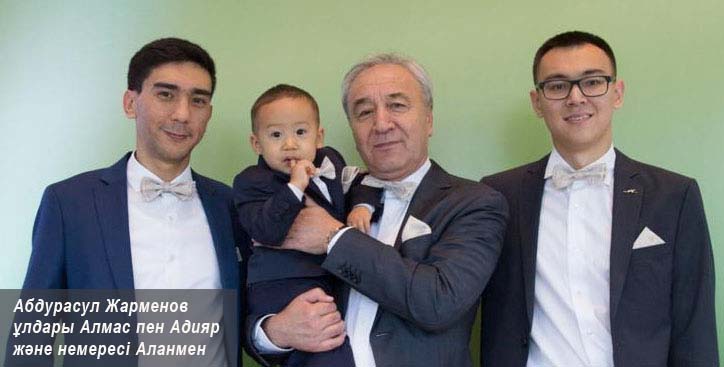
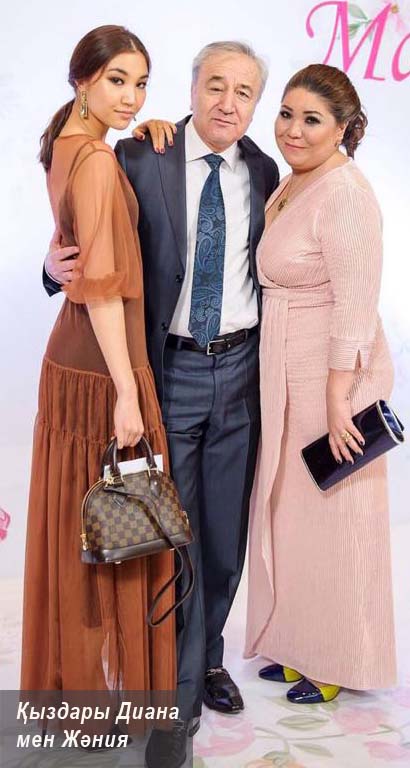
I have Diana and Almas from Svetlana. Diana is 38 years old, she graduated from Narkhoz University. Almas is 33 years old, he is a metallurgist.
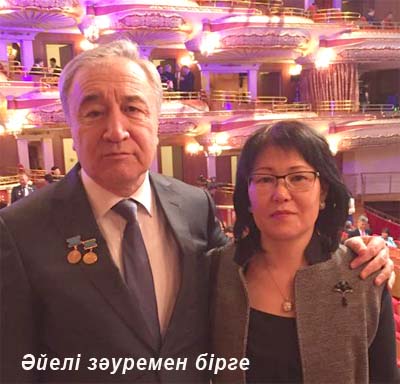
My second wife is Zure, my student, I saw her in the hallway of the university and immediately fell in love. She was an excellent student, active and fair. I supervised her thesis. At university, she showed courage by defending her position.
After moving to Almaty, Zaure worked at the university for 4-5 years. Then, when her daughter turned 6, she quit her job to accompany her to dance classes and competitions.
From Zaure, I have a son, Adiyar, and a daughter, Jania. Adiyar studied at New York University, and now has a master's degree in San Francisco, specializing in natural resources.
Zhenya lived abroad from the age of 10, studied at a dance academy in Switzerland, became a Swiss champion, then a world vice champion in Italy, then taught Hollywood stars, enrolled in Barcelona, but stayed in Kazakhstan, marrying a Kazakh. She is 22 years old now, and we have a child.
– Many grandchildren?
– Almost ten. The eldest is already married. I try to pay attention to them, visit their homes, take them home with me. I especially love my nephew, my grandson, who is seven months old. I keep an eye on him from six to eight in the morning, and when it's warm, we walk outside.
– You look younger than your years. What's the secret? Proper nutrition?
– Zara tries not to give too much fat. But I say, "Okay, eat whatever you want at home, but at the reception, don't touch me" (laughs). I can drink alcohol, I smoke only at work, I don't smoke.
– Do you drink often?
– No, rarely. Usually for work. For example, yesterday at a meeting with foreigners. Sometimes with classmates. I love red wine in Spain.
– What do you do in your free time?
– A hobby is dreaming.
– What do you dream about?
– I want children to have no problems, so that everyone finds their place in life. In order for technology to rise to a new level at work, the salaries of employees were decent, so that no one in the institution was left without an apartment. If we build a factory abroad in 1-2 years and earn a lot of money, I want to improve the conditions of employees, repay loans, and help families with children. I hope in a year and a half I will realize this dream, because the institution has given me a lot. I can't change the whole country, but at least make the social status of the employees like in Norway.
Interlocutor: Nargiza Arshidin
Source: Zhuldyzdar Otbasy Magazine, No.21(304), November 1-15, 2019
Other news
ПРОТОКОЛ заседания конкурсной комиссии
День металлурга в Национальном Центре по комплексной переработке минерального сырья Республики Казахстан
Materials on the submission for the assignment of the academic title of associate professor: Alimzhanova A.M.
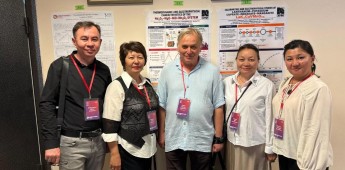
Казахстанские ученые представили разработки в области полупроводниковых материалов на международной конференции RCCT-2026