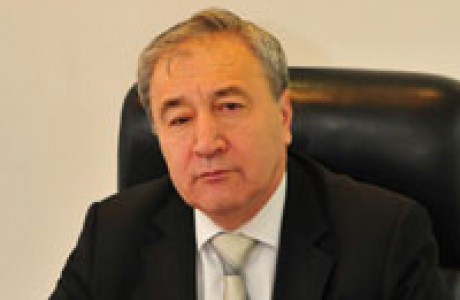
Abdurasul ZHARMENOV, General Director of the National Center for Integrated Processing of Mineral Raw Materials of the Republic of Kazakhstan, twice winner of the State Prize of the Republic of Kazakhstan, Academician of the National Academy of Sciences of the Republic of Kazakhstan
– Abdurasul Aldashovich, to what extent has your Center been able to ensure the technological progress of Kazakhstan?
– The main problem of Soviet science, which was often talked about, was a weak connection with production: developments remained on the shelves and were not introduced into production.
Therefore, when creating our center working in the mining and metallurgical industry, the first task was to strengthen ties with production. It included not only academic institutions, but also other institutes working in the manufacturing sector. Speaking about the results, over the past 25 years we have implemented a number of our technologies in production facilities not only in the country, but also abroad, launching new plants for the production of copper, zinc, lead-zinc and steel plants. The total investment amounted to $3.5 billion, of which 30% was realized in Kazakhstan and 70% abroad. Factories in Canada, Italy, Brazil, Bolivia, China, Russia, Ukraine, Uzbekistan, and Kyrgyzstan now produce products worth at least $4 billion annually. It is planned to invest another $4 billion in our technologies in the next two years.
– The potential of our scientists in the USSR occupied the 3rd-4th place. Now they say that the discoveries and technologies of that time were not implemented. How effectively is the scientific potential of your Center being used?
– Many technologies of that time were outdated and not in demand. If you ask if the technologies needed in practice are currently being developed, I can confidently say yes. New technologies are being introduced in different countries, factories are being created and built. In Kazakhstan, new enterprises, except Balkhash and Zhezkazgan, now produce about 50 thousand tons of copper per year, products worth 350-400 million dollars. We are confidently in the first place in the CIS in terms of implementing our own technologies. Financing: 30% from the government, 60% from enterprises using our technologies, 10% from abroad.
– There has long been talk about the need for changes in the science funding system. Is there any progress?
– Previously, the government fully funded scientific institutions, from 1995-96 they switched to competitive financing. In the last 2-3 years, basic financing has been introduced – part of the funds is allocated for the maintenance of buildings. I believe that fundamental research cannot be compared directly. They are difficult to prove and evaluate at once. For example, Einstein did not know that his theoretical work would lead to the creation of the atomic bomb. This is the case in fundamental science. You can't ask when it will be put into production – it's completely absurd. We finance fundamental projects, but we cannot limit them only to competitions. It is necessary to pay at least the minimum wage so that institutions can exist. Historical and social sciences also require funding. For new productions, a competition is needed to compare payback and implementation time. This reduces disputes about funding and increases the responsibility of scientists. No one has the right to ask, "What are you going to create?" but it is quite fair to ask the results of the work of institutions that have been operating for 40-50 years. If there is no result for 4-5 years, the institute can be closed.
Science financing is a key issue. It is extremely low in our country, far from the global average. We are inferior to neighboring countries. No increase in support is expected in the near future, although it is being discussed at meetings of the Higher Scientific and Technical Commission. The prime minister promised to increase support, but no country is catching up.
– Are you satisfied with the level of young professionals coming to work at the Center?
– To date, I have not seen well-prepared graduates come. We prepare everyone ourselves. For example, chemistry graduates sometimes cannot write the formula for sulfuric acid. School and university education does not meet the standards. This should be decided by industry experts, not me.
For the last 3-4 years, all training has been conducted in practice. We never say no. The requirement to perform work strictly according to the needs of production is a mistake. A researcher must create something that cannot be foreseen and that manufacturing enterprises do not see. For example, our ferrocinc "Kazakhstan" is recognized in the world, factories are being built in 5 countries using its technology. No factory could have given such an order – we were the first to invent the alloy, develop the technology and spread it around the world. Ministries still require a certificate to finance science – this is a misunderstanding of science. Science should not be subordinated to production, it should be ahead. The modern equipment of our research centers is worse than the factory equipment. How do I get ahead?
– Do you have a scientific and technical base for testing innovative products and technologies?
– Not in Kazakhstan. Only in our institution, there is no such thing in any other scientific institute. We have preserved the equipment from the Soviet era. There were only 4 such testing centers, and we are the only ones that have been preserved. Now the CIS countries and other countries are contacting us for testing. The government was supposed to provide us with this, but we plan to purchase the necessary equipment with funds from the sale of technology, gradually. We have not been able to provide housing for 25 years, but in a couple of years we will be able to. We will also raise your salary.
– They often talk about attracting private investment in science, but there is no result. What is the reason?
– Private investors are targeting countries like Finland, where 70% of science funding is private. The result of science is visible in 40-50 years. If I know that I will see results in 50 years, I can invest. If not, I won't. Only 10-15 countries in the world have private investments in science, and all of them are stable and developed.
– Why is the share of non-primary industries in the economy lower?
– Everything is privately owned and the profit is lower than that of oil. Perhaps this year we will catch up with oil. In the USSR, non-ferrous and ferrous metallurgy occupied about 50%, then oil surpassed. If the price of oil falls, the share of metallurgy will increase again.
Metallurgy has not fallen much since Soviet times. Copper, zinc, and lead are produced at the USSR level. A new aluminum production facility has appeared, which was not there before. Ferrous metallurgy has halved, phosphorus production has fallen, and chemical processing of chromium has decreased slightly. The shortage of rare metals is due to the unstable price.
– Many scientists face difficulties in obtaining copyrights for their discoveries. How do you solve this problem?
– There have been attempts to steal our ferrocinc technology 4-5 times, even a factory was under construction in Poland. We stopped it through the court and negotiations. The patent was issued by us first. Later, it was finalized through Swiss specialists, spending money on 6 months of work by lawyers and technicians. We currently have a large legal department. Deceptions and lawsuits are a part of life.
– Previously, scientists had a high social status. How do I get it back?
– In the Second World War, Soviet scientists made a huge contribution, created the best planes and tanks. After the war, Stalin raised the salaries of scientists 100 times, they were higher than the ministerial ones. Before the collapse of the USSR, scientists had a high status. Now the salary of scientists is lower than that of a janitor in a bank. If you pay well, young people will strive to become scientists.
– Thanks for the interview!
Yerlik YERZHANYLY, Gazeta Law
Source: zanmedia.kz
Other news
ПРОТОКОЛ заседания конкурсной комиссии
День металлурга в Национальном Центре по комплексной переработке минерального сырья Республики Казахстан
Materials on the submission for the assignment of the academic title of associate professor: Alimzhanova A.M.
Казахстанские ученые представили разработки в области полупроводниковых материалов на международной конференции RCCT-2026