The further progressive development of Kazakhstan against the background of a change in the configuration of the economic systems of most countries, as President Nursultan Nazarbayev points out, should take place through the construction of a knowledge-based economy. In this regard, the role of Russian science in creating scientific and technical foundations for the effective implementation of innovative industrialization projects in the country is increasing.
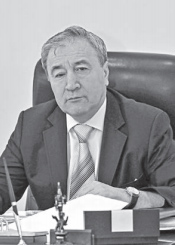
Abdurasul ZHARMENOV, General Director of the National Center for Integrated Processing of Mineral Raw Materials, Academician of the National Academy of Sciences of the Republic of Kazakhstan, twice winner of the State Prize of the Republic of Kazakhstan in the field of science and technology:
The scientists of our center took seriously the call of the Head of State to take an active part in the implementation of the National Plan "100 concrete steps" and the implementation of reforms as part of the large-scale modernization of Kazakhstan. Nursultan Nazarbayev's program article "The Nation's Plan – the path to the Kazakh Dream" sets the task of growing a critical mass of competitive, high-tech industries. And this is a direct requirement for the formation of a strong national science. A science that functions in close connection with a business that works for production. We are talking about the development of promising sectors of the economy based on innovative technologies, for which it is planned to attract new sources of external investment.
Since the first days of the country's independence, a network of national centers for priority areas of the economy has been established by Presidential decree. Among them is the National Center for Integrated Processing of Mineral Raw Materials. Its activities are aimed at ensuring the sustainable development of the mining and metallurgical industry through the creation of scientific foundations, the development and implementation of competitive technologies to ensure a technological breakthrough in Kazakhstan.
Analyzing the results obtained over the years, it can be argued that the tasks set are being successfully implemented. The organizational structure of the center allows for a systematic solution to the problems of the mining and metallurgical industry through the creation, development, implementation and transfer of innovative technologies. This opens up prospects for the organization of highly processed metallurgical industries, ensures the development of industry and the growth of the country's exports. We have implemented more than 100 technologies in domestic enterprises. Our developments are used by enterprises in the CIS countries, North and South America, Europe and Asia. Scientific and technical solutions are patented in different parts of the world. Their geography is quite wide. These are Kazakhstan and Russia, Kyrgyzstan and Ukraine, the EU and the USA, Algeria and Mexico, South Africa and China, South Korea and Hong Kong, Australia and Japan, India and Brazil, Chile and Indonesia.We work closely with companies that are global giants in metallurgy. Among them are Thyssen Krupp, Posco. Nippon Steel, Kobe Steel, HANWA, Baosteel, Sinosteel, JinZhou Tian Sheng Heavy Industry Co. Ltd, Zhuzhou Smelter Group Co., Jiangxi Copper Corporation. The result of the work is the conclusion of licensing agreements for the use of our technologies and, moreover, the attraction of foreign investment, which is aimed at by the Head of State. This confirms the recognition of our scientific achievements abroad. I think I would not be mistaken if I said that today in Kazakhstan there is no such other scientific organization as the National Center for Integrated Processing of Mineral Raw Materials.
At this stage, the center has a number of technologies ready for implementation. This was preceded by many years of work, from laboratory research to pilot testing. A number of works are already at the stage of commercialization. The most advanced project is the Kazakhstansky alloy. This multifunctional alloy for deoxidation, alloying and modification of steel is patented in 115 countries around the world. It has not only withstood the tests of demanding foreign experts, but has also shown high efficiency in steel production at Thyssen Krupp and Posco plants. Nippon Steel, Kobe Steel, etc. Currently, the company that bought the rights to the technology and to manufacture this material is building factories in different countries. The alloy is produced at the LigasGerais Eletrometalgia Ltda plant in Brazil. Work is underway on the construction of the 1st stage of a ferroalloy plant with a capacity of 21,000 tons of alloy per year in Tash-Kumyr, Kyrgyzstan.
As patriots of our country, we worry about the domestic economy. Therefore, it is gratifying that our technology is used to build the 1st stage of the Karaganda Complex Alloys Plant. The work is carried out in cooperation with foreign investors. The President of the Republic of Kazakhstan, as a co-author of the alloy, shows interest and oversees the implementation of the project.As part of the implementation of the instruction of the Head of State on the creation of a metallurgical cluster in the Kyzylorda region, together with JSC NC SEC Baikonur, the issue of building a ferroalloy plant here using the technology of the National Center is being resolved. The uniqueness of this technology lies in the fact that for the first time non–traditional raw materials are used for the production of alloys - rice processing waste, known as rice husk. We have created a technology for its processing. By the way, this invention was recognized as the best according to the results of the republican contest "Shapagat". The idea of producing ferrosilicon of special quality using rice husks turned out to be overwhelming and immediately aroused great interest among the giants of the world metallurgy. The fact is that traditional ferrosilicon, with its huge production volumes (8 million tons), contains up to 2% aluminum and titanium. Therefore, it is unsuitable for the production of some special grades of steel. The uncovered demand for "pure" ferrosilicon exceeds 300 thousand tons. Ferrosilicon produced by innovative technology meets the quality requirements for titanium and aluminum content.
For developments in the field of non–ferrous metallurgy, in particular in the production of lead and gold, the team of authors of the National Center was recently awarded the State Prize of the Republic of Kazakhstan in the field of science and technology (A. A. Zharmenov, as the head of this cycle of work, was awarded the State Prize of the Republic of Kazakhstan for the second time). However, the topic of non-ferrous metallurgy is not closed for us. To provide the domestic market of Kazakhstan with metallic antimony, a unique technology for obtaining metal from the industrial product of Kazzinc LLP has been developed. An industrial product is an antimony concentrate. It is formed during the purification of the base metal from harmful impurities. Currently, a pilot site with a capacity of 600-800 tons of antimony metal per year with 100 percent Kazakhstani content is being organized.
As a scientist and head of a company with experience in implementing scientific solutions in industrial enterprises (the technologies for processing copper and chromium electrolytes developed by A. A. Zharmenov were introduced in Soviet times at Balkhash-Copper and Kargormash software with significant economic effect), I cannot but to tell about the sore point. It's no secret that many scientists today are wishful thinking when they position laboratory research results as ready-to-implement developments. The process of launching a new product is quite laborious and costly. The main problem that prevents the rapid promotion of Kazakhstani innovations even within the country, not to mention abroad, is the imperfection of the science financing system. This issue is the subject of discussion at different levels.
The funds allocated for science are enormous, but they are being dispersed bit by bit into many projects. Since the financing of scientific research is based on a competitive basis, each research team puts forward several works for the competition with the hope that some of them will pass. If a scientist doesn't have a funded topic, he doesn't have a job. As a result, we have the support of an army of scientists. Of course, it is necessary. However, it is not necessary to count on a breakthrough result in science. In today's realities, it is necessary to provide for the allocation of a certain amount of funding for research organizations without a competition. The Research Institute's funds should be used for basic research and development. The allocation of funds by topic should be conducted by the academic council of the organization. Conducting grant funding competitions for fundamental and exploratory work is unacceptable. It is impossible to compare the works of such a plan.
Competitions should be held for applied work and for pilot tests. At the same time, choose as many jobs as the budget allows for 100% financing of reasonable costs. Touching on the topic of cost justification, again using the example of my own, in this case unsuccessful experience, I must say that there is a lack of mutual understanding on this issue between the scientific organizations implementing the projects and the relevant funding structures. I'll give you an example. We have prepared an application for a project involving pilot testing. The project was rejected on the grounds that, I quote: "the cost estimates for conducting pilot tests indicate activities not related to research work, namely: energy costs, depreciation of equipment, operating costs, materials, wages for workers." Comments are unnecessary.
The result is labor costs for proving obvious things, loss of time, but the saddest thing is holding back the implementation of a promising project for the economy of Kazakhstan. The fact that the project really deserves attention can be judged by the position of a foreign company. The investor is ready to invest his funds in the creation of production, provided that we provide the results of pilot tests. It is important that the call of the President of our country to successfully walk the path to the Kazakh dream be felt by every citizen of Kazakhstan. It is important to understand that the institutional reforms of the state begin with the renewal of each individual, rethinking his worldview, his role and responsibility to the country, to future generations. We, the scientists of the National Center for Integrated Processing of Mineral Raw Materials, will make every effort to ensure the innovative development of the state and build a competitive knowledge-based economy.
FROM THE EDITORS
We congratulate Academician Abdurasul Zharmenov on being awarded the 2015 State Prize of the Republic of Kazakhstan in the field of science and technology and on his 60th birthday.
Other news
ПРОТОКОЛ заседания конкурсной комиссии
День металлурга в Национальном Центре по комплексной переработке минерального сырья Республики Казахстан
Materials on the submission for the assignment of the academic title of associate professor: Alimzhanova A.M.
Казахстанские ученые представили разработки в области полупроводниковых материалов на международной конференции RCCT-2026