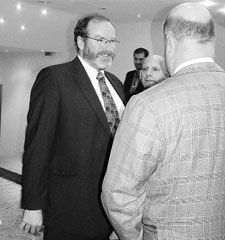
Recently, a presentation of Canadian companies supplying equipment for the mining and oil industries was held in Almaty. The meeting with representatives of the local business community was organized by the National Center for Integrated Processing of Mineral Raw Materials (NC KPMS) and the Canadian Embassy in Kazakhstan. K had a conversation with Canadian Ambassador to Kazakhstan Stephen Millar about what Canada is interested in in Kazakhstan and what is necessary for successful cooperation between the two countries.
– Representatives of the Government of the Republic of Kazakhstan have repeatedly visited Canada. Including at the highest level: in 2003, President of Kazakhstan Nursultan Nazarbayev paid an official visit to the country. But there has been no return visit from the Canadian Prime Minister yet. Why? And when can I expect it?
– Representatives of the Canadian government came to Kazakhstan. For example, the Canadian Finance Minister came to the Astana Economic Forum in May this year. He had his own program of visit – in particular, he visited Kokshetau and Almaty. The visit of our Minister of Agriculture was also scheduled for October, but it was postponed. Presumably, the visit will take place next year. In addition, businessmen from the province of Alberta visited Northern Kazakhstan. Representatives of the province of Ontario arrived in Almaty today (December 4 – "K"), so I do not agree with you that the Canadian side is not interested in Kazakhstan.
– As far as I know, in diplomatic practice, in order for a visit to take place at the highest level, it is necessary for companies to prepare contracts for signing for a certain amount.
– There are no specific plans for this right now. Contracts are signed every day, but it's too early to talk about major agreements.
– Did I understand correctly that the visit of the Canadian Prime Minister is not planned yet?
– No specific date has been set, it is also premature to talk about this.
– Which sectors of the Kazakh economy are Canadian businesses interested in?
– Mining occupies the largest share in the relations between the two countries. First of all, it is Cameco, which works together with JSC NAC Kazatomprom on uranium mining – it has the largest contribution. This sector continues to develop. In addition, the agricultural business is showing good dynamics – we see how contacts between Canadian and Kazakh firms are growing.
– As for Cameco: in order to conclude an agreement between Kazatomprom and Cameco on the peaceful use of atomic energy, an intergovernmental agreement on the peaceful use of the atom must be concluded. As Vladimir Shkolnik, the head of Kazatomprom, said in an interview with K this summer, it is expected to be signed by the end of this year. December has already started, so what about the agreement?
– I hope that it will be signed soon. According to my information, the latest details are being agreed upon.
– What is the reason for the delay?
– The fact is that there have been structural changes in the Kazakh ministry, which is responsible for nuclear energy.
– Ministry of Industry and New Technologies?
– Yes. Now a specially designated agency is engaged in nuclear energy. In addition, the agreement is stalled due to the fact that it must be translated into four languages: French and English (Canada has two official languages) on our side, Russian and Kazakh on yours. I know that you signed the agreement with Japan only in English. We can't do that.
– It is clear: difficulties of translation. Another question: at the presentation of Canadian companies, which was organized by the Canadian Embassy in cooperation with NC KPMS, it was about the agreement that Kazakhstan signed with Germany. Its essence: mineral resources – in exchange for technology. How interesting is such an agreement for Canada?
– I think this option is interesting for Canada, but no more. So far, no action has been taken to ensure that it is signed. However, an agreement on mutual protection of investments is currently being developed. The next round of negotiations took place in September this year, when the Kazakh delegation was in Ottawa. This is not quite the same as what you said about Germany.
– What is the essence of this document? What provisions are prescribed in it?
– I can only say in the most general terms: if a Canadian business plans to invest in Kazakhstan, these investments must be protected. The same applies to Kazakhstani businessmen in Canada.
– When, presumably, will this agreement be signed?
– Negotiations and expert consultations are currently underway, so I find it difficult to name any specific dates.
– When you talked about the interest of Canadian companies in mining, was it rather about investments in the subsoil or about the supply of equipment for existing companies?
– First of all, it is the interest of suppliers.
– Why?
– Because when Canadian companies ask us about Kazakhstan, they are primarily interested in whether their investments will be protected. There are questions about Kazakhstan in this regard, so Canadian companies are in no hurry to invest in Kazakhstan's mineral resources.
– Please explain.
– There are many markets that can attract investors in the mining industry. Canadian companies are mobile and well-developed, and they are considering a wide variety of investment options. But for one reason or another, not all companies are interested in considering Kazakhstan as a prime example for the development of their business.
– What are these reasons?
– Different.
– For example?
– It may be that they know other countries better than Kazakhstan, so those territories are more attractive to them. Business conditions can also play a crucial role, because companies analyze opportunities purely from a financial point of view. Not only such large companies as Cameco, but also others operate in Kazakhstan. For example, for uranium, I can name Uranium One, which was Canadian until it was bought by the Russian Atomredmetzoloto. In gold mining, these are Alhambra resources and Ivanhoe Mines, which has now been renamed Turquoise Hill Resources. These companies have been successfully operating in the Kazakhstan market for a long time.
– But, to be honest, it is difficult to say that Ivanhoe Mines is working successfully: it still does not extract gold. And Alhambra complained about tax problems in its messages.
Of course, I can't speak for these companies, but the fact that they still work in Kazakhstan and don't run away from here, even though the world is huge, speaks volumes. Investors are not inclined to waste money. But there is another aspect to the topic of investments in Kazakhstan.
– Which one?
Let me remind you that Canadian companies are much more interested in supplying equipment to Kazakhstan. Sooner or later, the suppliers who work here realize that the Kazakh side has expectations that they will create joint ventures here and bring technologies that Kazakhstan is interested in. There are high expectations for supplier companies to turn into investors.
– In what way?
– That they, firstly, will establish their representative offices here, secondly, establish contacts with local partners and, finally, will set up production here on site. Therefore, the companies that we now call suppliers are potential investors.
– How likely is it that suppliers will become investors?
– It depends on many factors: whether there is a demand for their products or not, whether they themselves are ready to make any efforts necessary for the normal conduct of business: to establish cooperation, establish contacts and production. Such actions require a lot of money. And our companies are mainly small and medium–sized enterprises, that is, businesses that count every penny. And the road to Kazakhstan alone is expensive and long. Therefore, it is more difficult for suppliers, who are far from such large investors as Cameco. They should understand that if they want to establish a long-term relationship, they should definitely explore this issue for themselves. They won't be able to work without it. Representatives of the mining industry were talking about the need to set up a business in Kazakhstan at the presentation of Canadian equipment suppliers.
– At the presentation, industry participants also said that it is difficult for foreign companies to participate in supplies in the Kazakh market due to the fact that they lose to local players in terms of the share of Kazakhstani content and, accordingly, cannot receive a discount. At the same time, it was noted that restrictions can be circumvented. How would you comment on these words?
– It is in the interests of Kazakhstan to make the conditions for entry into the local market easy for investors.
– So it would be right if the practice of informal arrangements acquired a formal status, for example, the law?
– No, I didn't say that. But it will be useful for the investment climate if the rules of the game for market participants are simple.
– Thanks for the clarifications. What is the volume of mutual trade and investment between Canada and Kazakhstan?
Canadian commodity exports to Kazakhstan increased from $115.8 million in 2005 to $210.7 million in 2009. Due to the global economic crisis, however, Canadian exports of goods declined to $140.6 million in 2010. Compared to 2010, Canadian investments in Kazakhstan increased by $700 million in 2011. In 2009, Canadian companies invested approximately $2.1 billion. mainly in the mining industry. As for the data for 2011, Canadian exports amounted to about $152.5 million, Canadian imports – $2.854 billion. Accordingly, the total trade turnover last year was at the level of $3 billion. There is no data on investments in Canada from Kazakhstan. Canada has invested $4.2 billion in Kazakhstan.
– Can you tell us the preliminary results of 2012?
– Not yet, we'll get the numbers later. Canada is one of the ten largest investors in Kazakhstan, according to the National Bank of Kazakhstan.
– How do you assess the prospects for mutual cooperation between our countries?
– I think the prospects are good, especially in the mining sector and agriculture.
– Regarding agriculture: what is Canada's interest in Kazakhstan?
First of all, it is cattle breeding.
– Dairy or meat?
– Meat. Another area is equipment for agricultural work on grain crops. The third area is genetics. The similarity of climatic conditions plays an important role in the interest between the companies of both countries. For example, in the western regions of Canada, the climate is almost the same as in the north of Kazakhstan. Therefore, we can offer breeds that are well adapted to this climate. There are examples when cows graze in a field in winter.
– Do I understand correctly that breeding cattle is the main area of interest in agriculture between the two countries?
– Yes. Canadian companies supply animals to Kazakhstan.
– And the supply channels?
– To the Black Sea – by sea, then by rail.
– Some time ago, the Kazakh media reported that Canadians were going to supply horse meat to Kazakhstan, one of the country's traditional products. Can you tell me if this idea has been implemented?
– As far as I remember, there really are some small exports. This is not to say that this business is widespread: horse breeding is not our traditional activity.
– As for cooperation in the financial sector, you said that your finance minister came.
Yes, but he was also more interested in agriculture.: he had a personal interest, as he himself is a farmer who grows grain, so it was very interesting to him.
– For grain – are we talking about breeding?
– No, our exports are harvesters, tractors and other equipment.
– And cooperation in the financial sector itself – banks, stock exchanges?
– There is no one yet. Our banks are mainly engaged in the domestic market and do not actively promote their business outside of Canada. Maybe that's why they're so stable (smiles). The same can be said for stock exchanges. I do not exclude that there may be some contacts, but at the level of conversations, no more. But if so, they don't go through the embassy.: we only deal with those who contact us.
Irina DOROKHOVA
Other news
ПРОТОКОЛ заседания конкурсной комиссии

День металлурга в Национальном Центре по комплексной переработке минерального сырья Республики Казахстан
Materials on the submission for the assignment of the academic title of associate professor: Alimzhanova A.M.
Казахстанские ученые представили разработки в области полупроводниковых материалов на международной конференции RCCT-2026