The National Plan "100 concrete Steps" defines the reorientation of the structure of scientific grants and programs to the needs of the SPIID, where special emphasis is placed on strengthening ties between science and business.
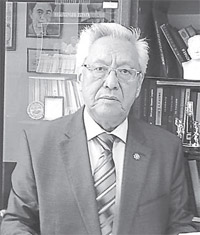
Sultanbek KOZHAKHMETOV, Academician of the National Academy of Sciences of the Republic of Kazakhstan, winner of the USSR State Prize
The National Center for Integrated Processing of Mineral Raw Materials of the Republic of Kazakhstan is almost the same age as the Kazakh state. The Center was established in 1993 by Decree of President Nursultan Nazarbayev. Today, the NC KPMS of the Republic of Kazakhstan unites the leading mining and metallurgical institutes in the field of non-ferrous and ferrous metallurgy.
Throughout its history, the center has been building its scientific activities in accordance with the priorities of the development of the mining and metallurgical industry. This is especially significant at the present stage, when the Head of State has defined in the National Plan "100 concrete steps" the reorientation of the structure of scientific grants and programs for the needs of the State Program of industrial and Innovative development. The President of the country has placed special emphasis on strengthening ties between science and business. And the center's scientists are confidently following this course.
An example of the high level of trust in the center was Elbasy's personal instruction to implement the idea of creating a fundamentally new product – the Kazakhstansky alloy for deoxidation, modification and alloying of steel. The alloy is patented in 15 countries. Including in the EU countries, the USA, South Korea, Australia, Japan, which show great interest in its production. Currently, the alloy is produced in Kazakhstan and Brazil.Scientists of NC KPMS RK have achieved tremendous success in the field of lead metallurgy. We are talking about the creation of a new technology for lead smelting by oxygen-suspended cyclone-electrothermal melting. In the non-ferrous metallurgy of the former USSR, a special place was given to solving the problems of efficient processing of polymetallic raw materials on high-temperature units. A copper-zinc KIVCET was built and implemented at the Irtysh Copper Smelter. This complex of works by Soviet, including Kazakhstani, scientists on its development and implementation in copper metallurgy was awarded the USSR State Prize in Science and Technology (S. Kozhakhmetov was among the team of authors – ed.). However, the problem of fundamental improvement of the lead-zinc sub-sector remained unresolved. In the 80s, the VNIITSVETMET Institute successfully implemented the industrial development of lead calcite in Bolivia, Italy and Kazakhstan at the Ust-Kamenogorsk lead-Zinc Combine.
However, at that time it was a question of replacing the energy-intensive and environmentally unsafe traditional technology of lead smelting with more efficient and environmentally friendly technologies for direct smelting of pure lead sulfide concentrates. The constant deterioration of the quality of raw materials, stricter environmental requirements and regulations have actualized the task of creating an effective technology for processing low-grade lead-containing raw materials of complex composition. Due to the outpacing growth of global zinc production in relation to lead production, the problem of efficient processing of high-iron refractory cakes was particularly acute. Therefore, over the past two decades, the center's scientists have significantly modernized the KIVCET process and melting unit for its implementation in large lead plants around the world. New technical solutions are protected by security documents of a number of countries. These include patents from Kazakhstan and Russia, Australia and Finland, Canada and the EU, China and Brazil, Mexico and India.
The authors of the new improved technology introduced fundamentally new solutions that ensure more efficient technological operations. New stages of technology have been proposed and industrially mastered, which significantly distinguish the upgraded KIVCET from other lead smelting processes. The viability and relevance of the upgraded technology is best demonstrated by the following facts. More recently, China's major steel companies are Jiangxi Copper Corporation and Zhuzhou Smelter Group Co. Based on the license agreements, we completed the construction and launched two installations with a design capacity of 100 and 120 thousand tons of lead per year. Earlier, in 1997, an installation was built and launched in Canada using the upgraded KIVCET technology. Modifications of the existing installation in Italy have also been carried out based on new technical solutions. Thus, today, 4 installations with a total capacity of 420 thousand tons of lead per year are operating in the world using Kazakhstan's upgraded KIVCET technology.Kazakhstani lead producers have something to be proud of and something to think about. Thus, in the context of global trends in depletion of reserves of high-quality raw materials, the issue of processing hard-to-enrich lead-zinc ores is also emerging for our republic. For example, from the fields of Zhairem and Shalkia. In this context, the use of the upgraded KIVCET technology seems to be the most effective.
Pyro- and hydrometallurgical technologies for processing gold-bearing ores, which have no analogues, occupy a special place in the annals of achievements not only of the center, but also of Kazakh science as a whole. This topic is quite relevant for Kazakhstan, as the country is the most important gold–bearing region of Central Asia. Despite this, there are problems: low quality and complex composition of ores. This causes difficulties, up to the impossibility of processing them. At the dawn of independence, gold was necessary for the country, and funds for the development of deposits and its production were limited. Hence, there was a need to create attractive technologies in terms of technical and economic indicators. The solution was found by the specialists of the center. And not just one, but each deposit has its own unique, patented one.
First of all, it is an innovative technology for heap leaching of gold from poor gold-bearing ores, complex gold-copper ores and man-made waste. In the early 2000s, about 15 enterprises were established in Kazakhstan using this technology, which annually processed more than 10 million tons of ore with a volume of extraction of about 10 tons of precious metal. The Dore plants in Ust-Kamenogorsk, Semipalatinsk and Stepnogorsk, with a capacity of 1.5 tons of metal per year, built using desorption and electrolytic gold extraction technologies, are successfully operating in Kazakhstan. Only in recent years, two gold recovery plants have been built and put into operation using the proprietary technology of the center's scientists, based on sorption extraction of gold from cyanide pulps – Akbakayskaya and at the Pustynnoye deposit. Their productivity is 1 million and 2 million tons of ore per year, respectively.
The high efficiency and successful industrial development of these technologies at large gold mining enterprises in Kazakhstan served as the basis for their implementation in a number of foreign countries. Thus, the developed new technology for processing gravity concentrate in special-design apparatuses for the Makmala gold extraction plant has been mastered in Kyrgyzstan with gold extraction of up to 99.5%. Two gold extraction plants (Angren and Marjanbulak) have been built in Uzbekistan using unique ion exchange technologies. This Kazakh technology has been implemented at the Asi gold extraction factory in China. Its productivity is 1.5 tons of gold per year. Experts from the world's largest gold producing companies, such as Barrick Gold, Newmont, and Placer Dome, noted the highest efficiency of implementing this technology at the Chinese gold extraction plant.
The scientific staff of the center has also solved the problem of processing certain types of gold-bearing raw materials with a high content of arsenic. They have developed a technology for oxidizing-sulfidizing roasting of such polymetallic ores and concentrates with the removal of arsenic in a low-toxic form. The technology was implemented with great economic effect at the Nezhdaninsky ore processing plant of the Dzhugdzhurzoloto Mining complex in Russia. Methods of pyrometallurgical opening of stubborn and double-stubborn core ores of gold have been further developed in the developments of Kazakhstani scientists.
In general, at the present stage, progress in metallurgy is inherently associated with the use of the most advanced technologies. It is encouraging that such technologies, created by Kazakhstani scientists, work not only in our country, but also on almost all continents, strengthening the image of Kazakhstan as a successful state, leading in these branches of science and industry. As part of the new industrialization of the country, the center and its research institutes have set even more ambitious goals. The successful implementation of these strategically important tasks corresponds to the fulfillment of the main purpose of the national center, whose credo is to serve science for the benefit of its people. This year, Head of State Nursultan Nazarbayev established the Al-Farabi State Prize in Science and Technology. NC KPMS of the Republic of Kazakhstan reasonably submitted to the competition the work of the team of authors "Industrial implementation of developments in the field of lead and gold metallurgy, which have made a significant contribution to the innovative development of the country and raised the prestige of Kazakhstan in the global technology market." These developments have been introduced into production at a number of domestic and foreign enterprises. Being one of the few examples of the transfer of Kazakhstani technologies abroad, they ensure an increase in the volume of metal production and an increase in the status of domestic science in the international arena. Therefore, I fully support this work of the NC KPMS RK, which deserves to be awarded the state prize.Other news
ПРОТОКОЛ заседания конкурсной комиссии
День металлурга в Национальном Центре по комплексной переработке минерального сырья Республики Казахстан
Materials on the submission for the assignment of the academic title of associate professor: Alimzhanova A.M.
Казахстанские ученые представили разработки в области полупроводниковых материалов на международной конференции RCCT-2026