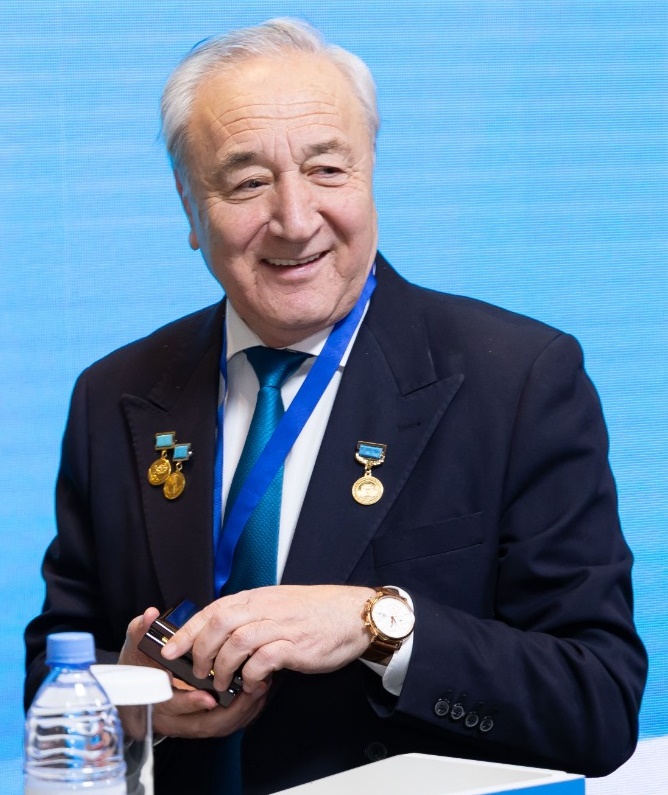
We met with Abdurasul Zharmenov, General Director of the National Center for Integrated Processing of Mineral Raw Materials of the Ministry of Industry and Construction of the Republic of Kazakhstan, twice winner of the State Prize of Kazakhstan, First Vice-President of the National Academy of Sciences of the Republic of Kazakhstan, Doctor of Technical Sciences, Professor, Honored Inventor of Kazakhstan, as part of the celebration of the 30th anniversary of the founding of the Center.
- Abdurasul Aldashevich, it's been almost four years since we talked. Then you bitterly said that Kazakh science is full of absurdity. What has changed?
- There are many changes. The biggest of them is happening around the National Academy of Sciences, which alternately makes you happy and makes you cry... I'll start over.
In 2003, the Academy, despite the loss of its state status and the ability to influence the state of science in the country, remained a very attractive organization for scientists. There was always a competition in the Academy elections, with at least 5-6 people applying for each position. The government respected either the academy or academics, in any case, the President of the country, constantly attended its meetings on the occasion of anniversaries.
The new President of Kazakhstan, Kassym-Jomart Tokayev, arrived at the celebration of the 75th anniversary of the Academy's formation, without violating these traditions. He did not just come, but came with a big gift - an order to return the Academy to the state status. Of course, this was the long-awaited dream of academics and every citizen who sympathizes with the academy. But I didn't have to be happy for long. During the execution of the presidential instructions, major distortions were made, the most incomprehensible of which was the assignment of the Academy's status not as a state-owned, but as a joint-stock company. For the first time in history, a person who has nothing to do with the Academy was appointed President. Both the first and subsequent heads refused to recognize the existing Academy and its academics. People who had never done science in their lives started electing academics. Applicants must submit their 5-year program, and for this they have begun to receive a very high title, which has always been awarded for outstanding, and most importantly, existing achievements in science. But here the title of academician is awarded for plans, I have never heard this before from the stories of Academies in any country. The Head of State has adopted another Decree restoring the rights of academics. However, almost a year has passed since then, but this decree is also not being implemented. It's a very confusing, incomprehensible situation. The recently adopted law "On Science and Technology Policy" named the Academy the highest scientific organization. What is behind this concept is not clear. It seems to me that if the President of the country does not intervene himself and finally put an end to this situation, then this situation will continue. However, assuming that perhaps everything will fall into place, in general, we can consider the instruction of the President of Kazakhstan to return the Academy to the state status as very correct and of great historical importance. That's the first thing. Secondly, government funding of science has increased significantly recently. Higher education institutions and scientific institutions subordinate to the Ministry of Higher Education and Science receive mega-grants that have significantly improved their material and technical condition. We have hope that our turn will come (when I say before us, I mean scientific organizations within the line ministries). The Minister of Industry and Construction of the Republic of Kazakhstan also promised funding for the creation of three industry laboratories. I think that this issue will find a positive solution in the imaginable future.The third big news is that starting next year, the regions are also required to start allocating money to science. This is a new business for akimats, and I am concerned about whether they will have specialists capable of managing such work. I think this problem can be easily avoided. Scientific organizations must find co-financing partners to commercialize their developments through the Science Foundation. I believe that it will be very beneficial for both the authors of the ideas and the akimats if the work on selection and expertise is carried out by the Science Foundation, which will involve the akimats in co-financing projects coming from their regions. At the same time, akimats get rid of the need to look for new employees, and scientists get rid of the difficult search for partners.
There are many other small and large news items that I will not dwell on.
- Abdurasul-agha, this year your company celebrated its 30th anniversary. What do you think about the work done for the country?
- Yes, we held the anniversary with a delay of about a year (due to floods). Our guests from all over the country and abroad positively assessed our achievements. We have many results that elicit their praise. According to our developments, dozens of enterprises have been launched and are operating in different countries of the world, and about 200 technologies have been implemented. This is a sure indicator that our scientists are in demand both in Kazakhstan and abroad. But such achievements do not appear on their own. All our successes have been achieved due to the great efforts of our enterprises. I thank the teams of all the institutes that make up our Center, scientists and specialists for their dedication to science and their country.
Without listing everything, I will mention two or three major works in recent years. Of particular note is the Center's contribution to the launch of workshop No. 4 at the Aktobe Ferroalloy Plant, where 4 DC furnaces with a capacity of more than 100 MVA each are installed with an increase in their design capacity. Such furnaces were built for the first time in world practice. Previous DC furnaces operated with a maximum capacity of up to 40 MVA. This year, the workshop celebrates its 10th anniversary since its commissioning. The Center's scientists have developed special slag formulations for melting ferrochrome, which have ensured the prevention of emergencies. The project team of the plant (ActFZ) has greatly contributed to the implementation of this work. These are almost entirely graduates of the graduate school of the Karaganda Chemical and Metallurgical Institute, which is part of our Center.
It is worth mentioning that tax revenues from the sale of products produced using our technologies only in ferroalloy, copper and gold mining industries amount to about 150 billion tenge per year, which is comparable to the country's budget expenditures for all science in Kazakhstan.
One of the latest achievements is cooperation with the Chinese company Jiaxin International Resources Investment Limited, an investor who invested $ 350 million in the development of the Boguta field. On November 30, the first stage of the mining and processing complex for the production of tungsten concentrate was put into operation in the Almaty region. It was a significant event in the history of the country. Reaching the design capacity of the enterprise will allow Kazakhstan to extract up to 10% of the global industrial volume of this metal. The future plans of Chinese entrepreneurs are even more ambitious - Kazakhstan's entry into the world's leading tungsten production.
- The center's scientists have great opportunities to develop a technology for processing tungsten ores," Liu Liqiang, Chairman of the Board of Directors of Jiaxin International Resources Investment Limited, said at a conference in Almaty.
- We are interested in cooperation and are ready to help in the holistic development of tungsten deposits in the Karaganda region using highly efficient integrated deep processing technologies. The investment portfolio of the project for the development of tungsten deposits can reach one billion US dollars. It is planned to create a world-class industrial park of tungsten products, create production facilities for 4,000 jobs, attract advanced technologies and significant investment flows to Kazakhstan. The relevant agreements have already been signed.
I told you about the achievements of today, and I think it would not be superfluous to mention 2-3 points that have had a huge impact on the life of our company over its 30-year history. In 2001, as a result of the high assessment of our achievements and confidence in our capabilities, the Government of the Republic of Kazakhstan issued a decree "On the transfer of the Zhezkazganredmet Industrial Enterprise to the Center (at that time, the post of Prime Minister was held by K.K.Tokayev - ed.). The resolution stated that the production was not subject to privatization and its preliminary stages. It was a completely unexpected decision for us. And, as the huge positive result showed, it was obviously an exceptionally correct decision. Since the transfer of the ZHRM to the Center, the technological performance of the enterprise has improved significantly. In less than a year, the production of ammonium perrenate increased by more than 1.6 times. We also managed to raise product prices significantly. Negotiations were held with Rolls Royce on the organization of the production of rhenium alloys in Kazakhstan, and work programs were developed to increase the extraction of rhenium and osmium from current and "historical" industrial products and waste.
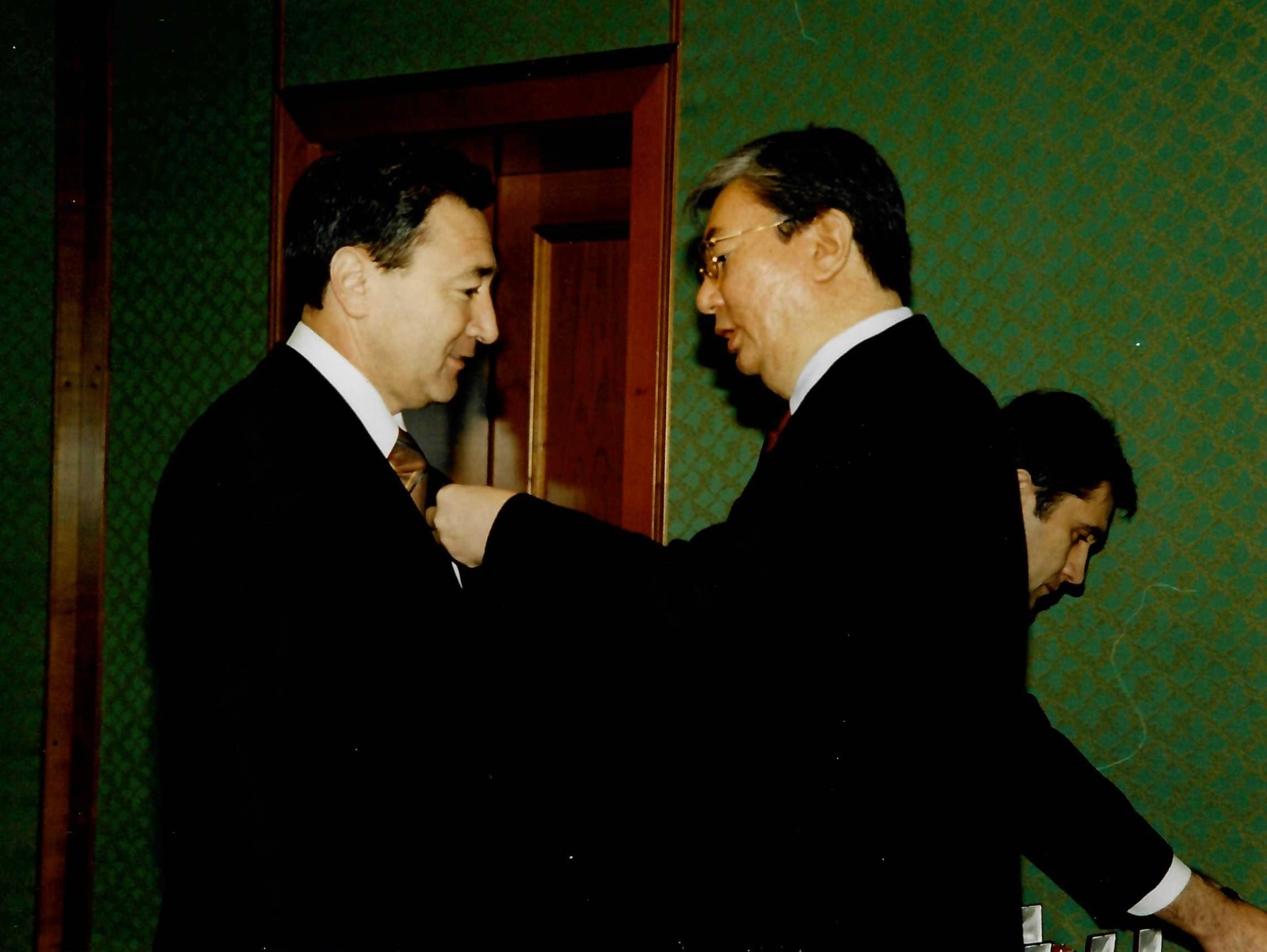
Prime Minister Kassym-Jomart Tokayev presents the state award to A.Zharmenov
From the very beginning, the Kazakhmys Corporation opposed the unification of the Center and the ZHRM and interfered with the normal operation of production. We also know that letters have been sent to higher authorities with false information about our work. Soon there was another change in the Government of Kazakhstan, and the new Prime Minister of the Republic of Kazakhstan, despite the conclusion of the interdepartmental commission created by him (which included representatives of line ministries and law enforcement agencies - ed.) on the effectiveness of maintaining the LRM in the Center, under pressure from the Kazakhmys Corporation, withdrew the LRM from our structure.
Simultaneously with the transfer of LRW to the Center, the Government of Kazakhstan submitted to the Parliament of the Republic of Kazakhstan a draft law "On the State Monopoly" (hereinafter referred to as the draft Law). The inclusion of a clause in this law on the preservation of the state monopoly on the production of rhenium and osmium sparked a heated discussion. The Kazakhmys company and its pocket deputies demanded to remove this item from the bill. However, those who supported the bill in the Majilis of the Parliament of the Republic of Kazakhstan demonstrated a majority (only four votes against). The Senate of the Parliament of the Republic of Kazakhstan was also ready to support this document. In order to prevent the adoption of the bill, the Prime Minister of the Republic of Kazakhstan, violating all procedural rules, returned it for revision on the night before the vote in the Senate. This decision has affected State interests in many other strategic areas. For example, I remember questions related to the production of black caviar, forestry, etc. And today this bill has not lost its relevance. On the contrary, if we take into account the increased global demand for rare metals and the real possibility of increasing ore production in our country, we can see that the demand for it has increased.
It is impossible not to recall the significant damage caused not only to the Center, but also to the state during that period by incorrect decisions of state structures. I am not talking about the endless inspections ordered by the Kazakhmys oligarchs, who did not allow us to work. The problem was that with the intensive growth of ammonium perrenate production, Kazakhmys Corporation banned the export of finished products from the territory of the enterprise through its checkpoints. I had to work at the warehouse. Kazakhmys ignored the right of servitude, which we received in court. We have made every effort not to stop production, even in the absence of sales. Kazakhmys and some government officials did not expect this. We ran into serious debts, but we did not allow the strategically important production to be stopped. However, we couldn't pay for the raw materials. However, this was not a violation, since, according to the agreement, payment should have been made only after the sale of the product. Despite this, the Corporation sued us and the Karaganda Regional Court upheld Kazakhmys in violation of all laws. We appealed to the Supreme Court of Kazakhstan, which overturned the decision of the Karaganda Regional Court. But three or four days later, we received an unexpected four-line letter from the Chairman of the Supreme Court withdrawing his decision without any explanation or justification. As a result, the Corporation took a significant part of our products at unreasonably low prices and caused losses to our company and the state in the amount of at least 50 million US dollars. This was a very serious blow not only to our company, but to the economy of the state as a whole, and to the development of the scientific field and the rare metals industry. After the withdrawal of LRW from our composition, production volumes decreased significantly in a short time. Our agreements with Rolls Royce and other plans to improve the operation of the LME remained unfulfilled. Despite the fact that we found ourselves in a difficult situation, we continued our activities quite successfully.
Another of our landmark achievements is the Kazakh alloy and the method of its production. The technology has been patented in many countries (USA, EU countries, China, etc.). The patent was sold to a subsidiary of the global metallurgical giant, the German Thyssen Krupp company, for 6% royalties. At a meeting with the CEO of the company, the head of state said: "This alloy was created in Kazakhstan, build the first plant here." They agreed. It turned out that this decision became a headache for us and for the alloy. Thyssen Krupp told the Deputy Prime Minister that he was ready to invest in this project in Kazakhstan together with South Korean companies Posco (turnover of $ 80 billion) and Japanese Hanwa (turnover of $ 40 billion). There was only one requirement: the Kuu-Chek coal deposit, which was not occupied by anyone at that time (the quality of coal was very poor), which was not needed by anyone, was requested as a source of raw materials. The decision on the transfer of this deposit has been waiting for 5 years. What kind of investor can withstand 5 years of waiting for such a trivial issue to be resolved! Everyone has serious grievances and claims against us. We managed to arrange a meeting with the President and Prime Minister of Kyrgyzstan as soon as possible. And they invested $25 million in the construction of a plant in Kyrgyzstan. However, 3-4 months before the launch of the plant, serious disagreements arose between the Kyrgyz and our Presidents. The Kyrgyz President stopped our project in retaliation. The amazing thing is that the Kyrgyz President, without hesitation, made a decision that harmed not only us, but also the economy and the people of his country. 7-8 years have passed since then, thank God, now we have reached an agreement with the Kyrgyz authorities and are working on continuing the construction of the plant.
There are other ways that can reduce the development of our technologies. So, the company of the Russian oligarch, which is based in Holland, has 4-5 years to implement our technology. Two years ago, the Deputy Prime Minister of Kazakhstan discussed a protocol resolution on the transition of our technologies without our agreement. We killed him, killed him. In the same year, our officials made a mistake and issued our patent within the framework of the law on the issue of non-existent assets. As it was, we went through it. I say that it is necessary that they have been and are expected to have a serious negative impact on the development of our center. We are very happy that it is important not only to improve technology, but also to implement measures to protect it, and this was a good resource for us. I believe that they and the government are aware of this and we have got our readers, who are interested in innovations.
- Is there any questions about such things, about which we want to talk?
-I am sure that I am satisfied with ITAK, but all the same, if I am satisfied with it. For another 5-6 years, the Ministry of industry and new technologies has signed our scientific program, stating that all new technologies and they can be taken from the internet, from different manufacturers. This is an absurd decision that has been taken for the first time since the release of important scientific work, and we have been able to get a post in the factory laboratory. Many good ideas have not yet been developed. Only this year it was possible to kill our ministry and we activated our program. I wish that in the further course of Kazakhstan's science there were no such serious decisions. We will direct all our readers with a New Year!
- Thank you for your attention! I want to say that Allah hranil washi Vern Dela from dark sil.
Erkin ZHAPPASOVICH,
Laureate of the International Literary Award "Alash" Eastochnik: Kazakh literature, week of literature, culture and art of the Republic of Kazakhstan, No. 51, Friday, December 20
, 2024
Other news
ПРОТОКОЛ заседания конкурсной комиссии
День металлурга в Национальном Центре по комплексной переработке минерального сырья Республики Казахстан
Materials on the submission for the assignment of the academic title of associate professor: Alimzhanova A.M.
Казахстанские ученые представили разработки в области полупроводниковых материалов на международной конференции RCCT-2026