
The adopted Law of the Republic of Kazakhstan "On State support for industrial and Innovative activities" is aimed at forming a unified strategy for promoting innovation in the country and the systematic development of innovation infrastructure. It defines direct and indirect state support measures, which are reflected in a number of legislative acts of the Republic of Kazakhstan. In particular, in accordance with the amendments to the Law of the Republic of Kazakhstan "On Subsoil and Subsurface Use", subsurface users are required to finance research, scientific, technical and (or) development work in the amount of at least 1% of the total annual income from contractual activities.
According to estimates of the Ministry of Agriculture of the Republic of Kazakhstan, this provision will increase the volume of R&D financing by subsurface users to $250 million already in 2012. The numbers are fascinating and impressive. From such a volume of investments in Kazakhstani science, one can expect not just its development, but a qualitative breakthrough. Naturally, this should have an impact on the development of the mining and metallurgical industry in terms of creating industries aimed at producing products with high "scientific and technical content." But the question arises: will scientific organizations receive the above–mentioned funds, or only part of them? And which part?
The mechanism of R&D financing remains controversial. In particular, on the issue of carrying out research and development work, it is still not clear whether subsurface users are required to involve scientific organizations to carry them out or have the right to carry them out on their own. Based on the definition of the concepts of "scientific research" and "scientific research", it is obvious that not only R&D not related to activities under subsurface use contracts (art. 76 of the Law of the Republic of Kazakhstan "On Subsoil and Subsoil Use"), but also performed under these contracts should be carried out with the involvement of subjects of scientific and (or) scientific and technical activities in accordance with the Law of the Republic of Kazakhstan "On Science".
At the same time, this does not mean that industrialists themselves will have to give up financing their own research and development to modernize their enterprises. We are talking about ensuring that the financing of scientific research is not reduced to self-financing or simply to supporting innovation proposals. A clear description of the mechanism for allocating at least 1% of the total annual income by subsurface users to finance research, scientific, technical and (or) development work will make it possible to resolve existing issues and organize their implementation with maximum efficiency for all entities involved in the activities under discussion and the country's economy as a whole.
The fulfillment of this commitment will contribute to the synergy of science and business in the industrial and innovative development of the state, increasing the effectiveness of domestic science in the implementation of innovative activities.
KOZHAKOV Bulat Eginbayevich
Head of Marketing Department at RSE NC KPMS RK, Candidate of Chemical Sciences
Kursiv newspaper, No. 33 (459), AUGUST 23, 2012
Other news
ПРОТОКОЛ заседания конкурсной комиссии

День металлурга в Национальном Центре по комплексной переработке минерального сырья Республики Казахстан
Materials on the submission for the assignment of the academic title of associate professor: Alimzhanova A.M.
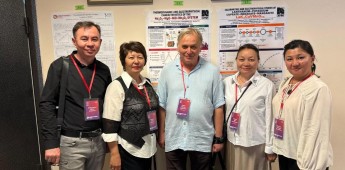
Казахстанские ученые представили разработки в области полупроводниковых материалов на международной конференции RCCT-2026