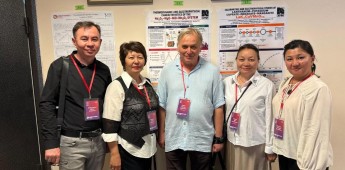
Recently, I became a participant in a seminar organized by the National Agency for Technological Development JSC on the topic: "International experience in business incubation of innovative companies and their introduction to the global market," which was lectured by the Director and founder of the L.N. Innovative Technologies business incubator, Ms. Clara Oren from Haifa (Israel), and on the topic "Fundamentals of marketing research and business planning", which were lectured by representatives of the A to Z Training Center (Kazakhstan), Mr. Samat Panov and Tleubek Tasov.
I want to tell you about the experience of technology commercialization in Israel and compare them with our realities.
Everyone knows that Israel is one of the leading countries in the innovative development of the global economy, and all the leading top companies are trying to open offices in Israel in the hope of finding and "intercepting" the most advanced ideas and projects.
Business and technology incubators in Israel are private. They themselves are looking for high-yield projects or they are approached by the authors of such projects, including from the CIS countries. The number of projects that have reached the stage of commercialization shows the rating (reputation) of an incubator. The initial verification of the viability of the project is carried out by the incubator staff themselves, in constant contact with the author of the project.
Subject to the passage of the first stage, the incubator conducts a second, in–depth stage - due diligence - with the involvement of "high" domestic and foreign experts in a particular field of economics, who constantly maintain both personal and commercial ties with the incubator.
In practice, technology incubators do not welcome the patenting of ideas and technologies at an early stage, as this will require the authors to spend extra money on both registration and maintenance of the patent. In addition, when examining a project by foreign experts, undesirable consequences may also "theoretically" arise, which often leads the authors to an "uncomfortable" state. At this stage, the presence of the author is very important, as only he can explain the essence of the idea, technology, without revealing his "know-how" in the project.
Here I would like to note that our financial institutions primarily ask about security documents, which forces authors and/or "particularly poor" research institutes to incur such costs.
Thus, if the project passes the second stage of the examination, then the incubator proposes and, together with the author, defends such a project before the Chief Scientist of the Department of Science of the Israeli Ministry of Industry. If approved, the project receives government funding in the amount of up to 500 thousand dollars, subject to private partnership from the incubator or co-investors up to 15% of the specified amount. You must agree, this is a real help in realizing your plans.
To implement the approved project, a special legal entity is created with the participation of the author of the project with a share of up to 50% (in our case, by agreement of the parties, it is possible to clearly and unambiguously determine the share between the employer and the author), an incubator with a share of up to 20%, an investor(s) with a share of up to 20% and with 10% of the reserve for key players.
The funds are transferred to the settlement account of the newly created company, management bodies, audits, etc. are determined. Control over the activities and expenditure of funds is carried out by the technology incubator, which in turn reports to the Chief Scientist of the Department.
As an idea or technology is introduced into economic circulation, or a prototype is manufactured, tested, and implemented, the company is appropriately capitalized, and shares of the company are then offered to potential investors on the stock exchange.
In case of successful commercialization of the project by the state, the sale of the company is allowed, subject to the return of state investments in 6 times the amount.
And what is happening in our country?
Why is the activity of the population working in the scientific and technical field and business, especially in the SME sector, not growing rapidly, but at a sluggish, low level? Maybe, on the threshold of the second five-year plan of the FIIR, we should rethink what is happening once again, review our laws, regulations, rules, and procedures. After all, something is preventing the active, widespread development of this process. Why do our scientific minds actively use or even do not want to use the created financial "benefits" to introduce their knowledge into the current economy? Why are they so passive?
In principle, the scheme of grant financing of projects adopted in our country through JSC NATR is also aimed at the commercialization of technologies. At the same time, in accordance with the approved rules, the grants allocated cover the amount of necessary funds for the project by a maximum of 50-60%, the rest should be funds from the co-investor(s). Unfortunately, the institution of private co-investment has not yet been developed, just as the sale of a start-up company or a share in the stock market has not been developed, and research institutes or universities are unable to invest the missing part of the funds. Inadequate financing is one of the reasons for the accumulation of projects that have not been implemented to their logical end within the walls of research institutes.
In addition, the status of the scientist, the author of the idea, and his share in the project are not legally defined in our country. These problems, which are not prescribed by law, when the remuneration for the work of the author of the project depends on the decisions of either the employer or the financial magnate investor, rather causes the authors to have a negative attitude towards the outside world than a positive one, which is one of the reasons for their passivity.
So, dear sirs, it may be necessary to eliminate all these obstacles first by initiating changes and additions to legislative acts regulating business innovation, and then our students, scientists and engineers will also provide the expected and sought-after innovative projects.
Employee
Office of Commercialization
RSE "NC KPMS RK"
Sarsebaev B.A.
Other news
ПРОТОКОЛ заседания конкурсной комиссии
День металлурга в Национальном Центре по комплексной переработке минерального сырья Республики Казахстан
Materials on the submission for the assignment of the academic title of associate professor: Alimzhanova A.M.
Казахстанские ученые представили разработки в области полупроводниковых материалов на международной конференции RCCT-2026