

The most interesting discoveries and inventions in the 21st century are increasingly occurring at the intersection of sciences. For example, physicists solve a problem and get the desired result, but it is ineffective for industrial applications. In parallel, chemists or biologists also solve this problem in their own way and also receive a positive, but ineffective patent for the industry. A similar story has been developing for decades with the problem of using rice processing waste. Kyzylorda residents, especially those who have been reading our newspaper for many years, know that this problem has been definitively and irrevocably solved at least five times by scientists from Kyzylorda, Kazakhstan and the former USSR. Rice husks were an excellent building material, fertilizer, firewood, sorbent, and a major component of many other things. Several times, enterprises were even created for the developed technologies, but all of them operated a little longer than their presentation lasted. The reason was always the same: the technology worked, but there was no profitability.
To be fair, scientists from countries where millions of tons of this grain are produced have also failed to find a cost-effective technology for converting rice processing waste into income. More precisely, there are successes in individual positions, but there has not yet been a comprehensive use of these raw materials.
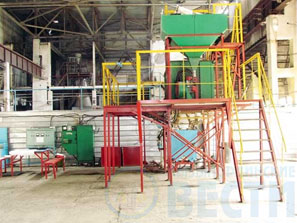
A few years ago, scientists from the RSE "National Center for Integrated Processing of Mineral Raw Materials of the Republic of Kazakhstan" took up the problem of producing promising materials from rice processing waste and developed a cost-effective technology. Svetlana Yefremova, Chief Scientific Secretary of the National Center, Professor, Doctor of Technical Sciences, told about this at the II Baikonur Investment Forum. Before the forum, for a month it was possible to see in operation an experimental thermal plant for processing rice husks, which the scientists of the center brought to Kyzylorda and installed on the basis of Dorstroy LLP. At the forum, and then on the phone, I managed to talk about a lot with Svetlana Efremova, and this interview turned out.
– At the Baikonur forum there was a section "Rice farming and meat husbandry – the basis of the agro-industrial complex of the region", and judging by the title of your report "Production of promising materials from rice processing waste", you were supposed to speak there, but to my deep satisfaction I managed to listen to you at the section "Prospects for the development of metallurgical and machine-building clusters". How did rice end up in a metallurgical cluster?
The fact is that the husk of rice is unique in its chemical composition and contains, among other things, an element such as silicon. By thermal means, silicocarbon can be obtained from rice processing waste, and a charge for metallurgy can be obtained from it. At least 500 tons of metallic silicon (99.5% Si) can be obtained from 1,000 tons of silicocarbon. It was from this perspective that we began, so to speak, to approach the topic of integrated use of rice processing waste. That's why we met in the metallurgical section of the forum, not the agricultural one.
We also have a material approach to metallurgy. Getting money for research and development of technologies related to metallurgy is somewhat easier than with agriculture. This is because the first industry is profitable all over the world, while the second is subsidized by the state everywhere. By the way, having started our own rice metallurgy, so to speak, we found ourselves in an interesting position. As a metallurgical project, we are too small for investment institutions in this industry – only three million dollars. But for an agricultural producer, 450 million tenge is already an unbearable amount of money. I have some confidence that your investment forum helps to find a place for projects like ours and ensures cross-interest in it.
– What is the uniqueness of the technology created in your center and why are you so confident in its commercial attractiveness?
– You don't represent a scientific publication, so let me answer your question in a simplified and popular way. The rice waste we are talking about has always been used to produce new materials as filler, fuel, and so on, processing it as organic or inorganic matter. We have set ourselves the task of simultaneously obtaining useful organic and inorganic materials. And our experience shows that a different approach will not ensure the profitability of the technology for processing these raw materials.
With an American grant, we have created a pilot plant for processing three hundred kilograms of rice husks per day. It was brought to Kyzylorda for demonstration to local agricultural companies. I must say right away that today we have advanced even further in this technology. Now let's see how it works. First, the process of hydrotreating the husk, then drying, then pyrolysis (thermal decomposition of organic and inorganic compounds) at a temperature of 600-650 ° C. As a result, we get a solid product – silicon carbon and a combined-cycle mixture. The inorganic silicon carbon product is used as a charge for silicon smelting, a filler for rubber production, a sorbent or a feed additive. We obtain organic products from the combined–cycle gas mixture - a growth stimulator, a disinfectant, and a flotation agent. By increasing the pyrolysis temperature, soot and gaseous fuels can be obtained from non-condensing gases. We will do the latter on large installations in order to reduce energy consumption.
– In order to understand the effectiveness of the installation created in your center, it is necessary to prove in practice the valuable properties of the materials obtained, their relevance at least in the Kazakh market.
– You're right, without this technology and even a ready-made installation, a potential consumer will not be interested. Our center has many partners in the scientific community who help us conduct comprehensive research. For example, our colleagues from the U.U. Uspanov KazNII of Soil Science and the Agrarian University tested the organic product obtained at our facility as a plant growth stimulator. A 0.5 percent solution of this stimulant increased the yield of alfalfa green matter on saline soils by 22.4 percent. For barley and corn, these figures increased by 26.3 and 28.6 percent, respectively. A solution of the same substance, but already in 50% concentration, proved to be effective as a disinfectant against tuberculosis and salmonella cells.
Tests of silica carbon have also been carried out in agricultural production. This was done at the Aksai poultry farm. The introduction of a three percent additive to the main feed increased the egg production of chickens by 8.6 percent, and most importantly, feed consumption per unit of body weight is reduced to 30 percent, poultry mortality is reduced by 28 percent and egg slaughter by 31 percent.
Another component produced at our plant is silicocarbon, which, in addition to being used in metallurgy (producing pure silicon), can also be used to produce silicon alloys and silicon carbide. Studies have been conducted on the use of silicocarbon in the production of rubbers instead of traditional carbon black and white soot, as well as in combination with them. And they showed that the elasticity of the products will increase by 10-12 percent, and the strength properties by 10-15 percent. Silica carbon is also used as a sorbent. For example, in the process of wastewater treatment from petroleum oil pollution, using silica carbon, it is possible to achieve recovery of up to 99.5 percent. Extraction of gold from productive solutions yields 91.4 percent (similar to expensive coconut coals). And, what is most interesting for your rice-growing and uranium-mining region, this sorbent allows you to extract 100 percent of rhenium from sulfuric acid solutions obtained by underground leaching of uranium ores. I can add to this that all of the above is confirmed by a series of patents of the Republic of Kazakhstan.– Now the most important question is: how profitable are the developed thermal installation and the proposed technologies for obtaining new materials from rice husks?
– The plant for processing 500 kilograms of rice husk per day is an experimental one, and with such a capacity it will not be profitable. And the volume of rice processing waste in Kazakhstan (about one hundred thousand tons per year, the husk accounts for 20-30 percent of the grain weight) requires industrial installations of appropriate capacity. Therefore, we plan to create a model with an annual processing capacity of 3,500 tons. According to preliminary data, its cost will be 440 million tenge. The operating costs will amount to 120 million tenge per year. The output of the main silicon carbon product will be at least 1,200 tons. Its cost even at the initial stage will not exceed 100 thousand tenge per ton. At the same time, a similar carbon black product costs from 240,000 to 700,000 tenge per ton on the Customs Union market. Of course, when entering this market, it is possible to oust competitors only by having lower prices, therefore, calculating the profitability of this module, we set the selling price of silicon carbon at 150 thousand tenge.
In addition to silicon carbon, a plant of this capacity will produce 900 tons of organic product, the properties of which were described above. Here, too, we operated with starting prices significantly lower than for similar products available on the market. With all this in mind, the payback period from the start of sales will not exceed three years. If we take into account the construction time, then, at most, five years. Moreover, these are all calculations for the first installation, the module. Subsequent ones should be cheaper and pay off faster due to the approval of real prices and products of the pioneer module on the market.
– Svetlana Vladimirovna, tell me, honestly. Do you have confidence that the first such module will appear in Kazakhstan in the near future?
– We do not have a specific investor partner today. Therefore, I cannot say that we will start implementing this project in 2014 or 2015, but the Baikonur Forum has given us very high hopes. We saw business interest primarily from SEC Baikonur, and we felt the support of the head of the region, Krymbek Kusherbayev. In the districts and rice-growing companies, our options are already being calculated. Believe me, this is a serious step towards starting a concrete project implementation.
– I really hope that next year we will meet with you to discuss specific plans for the construction of such a module in Kyzylorda. Thanks for the science.
Svetlana Yefremova is a graduate of KazGU. In 1999, she became a Candidate of Chemical Sciences. The topic of her dissertation is "Shungite carbon as a substitute for carbon black in the filling of composite materials." Pure chemistry is becoming scarce for a young, inquisitive scientist, and she is increasingly interested in developing technologies to achieve competitive results. This becomes the topic of a doctoral thesis. Its name is already closely related to our rice: "Scientific foundations and technology for the production of new carbon- and silicon-containing materials from man-made raw materials." Having received academic degrees in various sciences, Svetlana Efremova works at their junction.
Igor TITENOK
Source: www.kzvesti.kz
Other news
ПРОТОКОЛ заседания конкурсной комиссии
День металлурга в Национальном Центре по комплексной переработке минерального сырья Республики Казахстан
Materials on the submission for the assignment of the academic title of associate professor: Alimzhanova A.M.
Казахстанские ученые представили разработки в области полупроводниковых материалов на международной конференции RCCT-2026