It became the basis for the production of silicon-carbon material
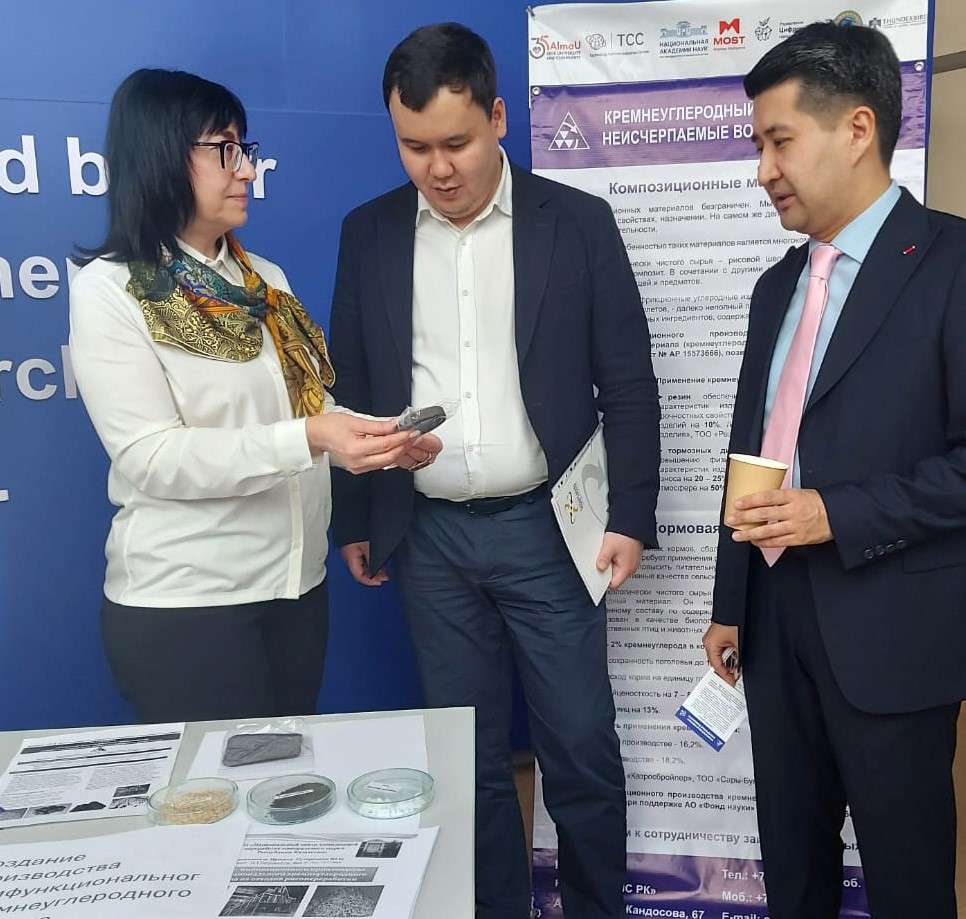
The project was implemented on the basis of the RSE "National Center for Integrated Processing of Mineral Raw Materials of the Republic of Kazakhstan". Its authors are the chief scientific secretary of the center, Doctor of Technical Sciences, Professor Svetlana Efremova and the head of her doctoral thesis, Professor Yuri Sukharnikov.
The introduction of scientific developments is one of the priorities of Kazakh science. The government not only focuses the attention of scientists on this, but also helps to carry out commercialization. Currently, the Science Foundation is financing a project to create a production of silicon-carbon material from rice husks. This stage became a logical continuation of Svetlana Yefremova's doctoral thesis.
According to her, in her doctoral dissertation she presented the scientific foundations of creating a technology for processing rice husks. A pilot plant was built in the center. The technology proposed in the dissertation was tested by the staff of the laboratory of silicon carbon composites and the experimental complex. It took several years to reach optimal modes.
Having studied the process thoroughly, scientists have improved the technology. Using the natural features of the source material and at the same time aiming to eliminate the harmful effects of its multi-ton formations (rice husks are not susceptible to rotting, like ordinary plant waste), they managed to develop a processing technology to produce a product that can be used in various fields due to its unique properties.
The product of the thermal processing of husks consists of the smallest carbon particles (practically soot) and silicon dioxide (sand, one might say, but of a different structure and much smaller size). In combination with other materials, it gives life to many important things and objects.
Experts believe that the world of composite materials is limitless. In everyday life, we don't think about their existence, properties, or purpose. In fact, they have firmly entered into all spheres of our life.
A distinctive feature of such materials is the "multicomponent unity". That is, formed by a large number of completely different substances, they act as a single whole and have completely new properties that differ from the properties of their constituent "bricks". An example of this is rubber mats, hoses, tires.
– No rubber product can be created without the use of special ingredients – fillers. Mineral and carbon are usually used. And our material works like two in one. As a filler, it provides an improvement in the technological characteristics of rubber products," the authors of the project explain.
So, rice husk has become a valuable raw material enriched with carbon and silicon. The uniqueness of the silicon-carbon product is confirmed by the fact that this material has found application not only in industry. Joint research with poultry specialists has established that it is non-toxic and, due to its balanced composition in terms of carbon and silicon dioxide, can be used as a biologically active substance in the feeding of farm birds and animals.
It turns out that the introduction of only 1-2% of this material into poultry feed significantly increases the safety of livestock and reduces egg slaughter.
Source: kazpravda.kz
Other news
ПРОТОКОЛ заседания конкурсной комиссии
День металлурга в Национальном Центре по комплексной переработке минерального сырья Республики Казахстан
Materials on the submission for the assignment of the academic title of associate professor: Alimzhanova A.M.
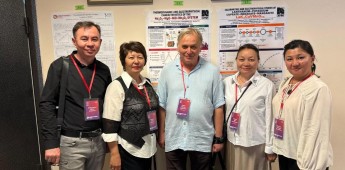
Казахстанские ученые представили разработки в области полупроводниковых материалов на международной конференции RCCT-2026