- Our center is the largest scientific organization in the country with a developed network of branches: Institute of Geology and Economics of Mineral Raw Materials, D.A.Kunaev Institute of Mining, Kazmehanobr State Scientific and Production Association of Industrial Ecology (all three are in Almaty), Chemical and Metallurgical Institute named after J.Abishev (Karaganda), the Eastern Scientific Research Mining and Metallurgical Institute of Non-Ferrous Metals (Ust-Kamenogorsk). There is a division specializing in conducting industrial tests of the developed technologies - the Metallurgy Center - and a branch in Astana.
The center and its branches employ 50 doctors and 100 candidates of sciences, 43 academicians and 14 corresponding members of domestic and foreign academies of sciences.
- And how did it all start?
- In 1992, President of the Republic of Kazakhstan N.A.Nazarbayeva issued a decree on the creation of a network of national centers for priority areas of the country's economy. That's when our center was established, as well as nuclear, biotechnological and others. They were designed to fix the main problem of Soviet science - the weak connection with production. The first general director of the center, my teacher, corresponding member of the National Academy of Sciences of the Republic of Kazakhstan, J.N.Abishev, entrusted me with this direction, since, working at the Chemical and Metallurgical Institute of the Academy of Sciences of the Kazakh SSR, I created a small production facility at the Balkhash Mining and Processing Plant for waste from copper-electrolyte production. At that difficult time, at the dawn of independence, with an acute shortage of funds, the Minister of Science - President of the Academy of Sciences of the Republic (then V.S.Shkolnik) allowed a significant part of the funding to be directed to conducting pilot tests of the technologies being developed. The results were not long in coming.
Over the past 2-3 years, a number of mini-productions have been created using our technologies in Karaganda and Ekibastuz. Despite their volumes, our researchers have gained significant experience in production. We realized the importance of taking into account any small details when organizing production, the need to explore sales markets, the availability of alternative sources of raw materials, etc.
Work has become more active with large industrial enterprises of the mining and metallurgical industry, which have become private. Many years of experience working with our ore materials helped, the specifics of which foreign scientific organizations could not know. During this time, we have implemented more than 100 developments at domestic enterprises, and their effectiveness, according to our calculations, exceeds 1 billion US dollars.
- Tell us about the first export technologies...
- We gained experience in international sales of intellectual property objects by working on the implementation of the famous Soviet-era technology of KIVCET in Canada and China. But the technology on the basis of which there are 4 QIVCET installations in the world today is not at all the same as it was 30 years ago. It has been significantly improved, which allows it to remain the most efficient technology for processing lead raw materials, its advantages are becoming more pronounced with the deterioration of its quality. Over the past 10 years, we have not only sold licenses for the construction of new plants, but also carried out the modernization of previously implemented production facilities in Bolivia and Italy. And today, every tenth ton of primary lead in the world is produced using this technology. The development of KIVCET in these countries has allowed us to gain not only extensive experience in international communication, but also a name on the global know-how market.
Our work in the field of processing hard-to-enrich gold-bearing mineral and man-made raw materials has also significantly enriched us in this regard. Every third ton of gold in the Republic of Kazakhstan is produced using the center's technologies. Dozens of gold processing plants in China, Russia, Kyrgyzstan, and Uzbekistan use our technologies. In accordance with the best international standards in the field of precious metals refining, our specialists have designed the refining plant in Astana.
- And how was the idea of creating ferrosilicon aluminum born?
- The President of the Republic of Kazakhstan N.N. became the generator of ideas for work in the field of ferrous metallurgy.Nazarbayev. It was at his suggestion that the Kazakhstansky alloy was created, which was patented in 115 countries around the world and showed high efficiency in steel production at plants in Germany, South Korea, Japan and others. Now the company that bought the rights to the technology and to manufacture this product is building factories in a number of countries around the world.
The idea of obtaining ferrosilicon of special quality from rice husks turned out to be stunning. The fact is that traditional ferrosilicon, with its huge production volumes (8 million tons), contains up to 2% aluminum and titanium, which makes it unsuitable for the use of a number of special grades of steel. The uncovered demand for it is more than 300 thousand tons. But ferrosilicon, obtained using rice husks, contains neither titanium nor aluminum. And, as a result, there is a huge interest from the giants of the global metallurgy industry.
The uniqueness of these technologies lies not only in the creation of new materials, but also in the fact that for the first time, not traditional ore materials are used for the production of alloys, but coal mining waste (in the first case) and rice processing waste (in the second).are, indeed, vivid examples of the successful promotion of scientific developments. But such cases are rare in Russian science. Why?
- The main problem that prevents the rapid promotion of Kazakhstani innovations even within the country, not to mention abroad, is the imperfection of the science financing system. I don't think I'm discovering America, as many people point out. In Soviet times, scientific organizations were funded based on the base number of research institutes, then we switched to competitive financing. Now there is so-called basic financing, which is used to cover utility costs, minor repairs and the maintenance of administrative and management personnel. VNTK and NNSi have been established, that is, constant work is underway to improve the system of financing science. The experience of industrial implementations of large developments (small ones are usually funded by interested enterprises) and the leadership of a research organization allow me to take the risk to give my suggestions.
In today's realities, it is necessary to provide for the allocation of a certain amount of funding for research organizations without a competition. The Research Institute's funds should be used for basic research and development. The allocation of funds by topic should be conducted by the academic council of the organization. Holding grant funding competitions for fundamental and exploratory work is absurd - it is impossible to compare works of such a plan.
This year I worked as a member of the NNS. We have reviewed the competitive applications of the teams that have passed the preliminary examination, including with the involvement of foreign experts. Many of the works, which is encouraging, received positive expert opinions, and in order to finance them, it was necessary to allocate funds for an average of 8-10 million tenge per job, despite the fact that applications were submitted for more powerful financing (up to 300 million tenge). And there is no reason to hope that the teams will efficiently complete the task in the amount of 10-30 times less than planned. But it is necessary, and this is important, to have a result!
At the same time, I would like to make a reservation right away that huge funds are being allocated for science today, but they are being dispersed into many projects, because each research team puts forward several works with the hope that some of them will pass, because if a scientist does not have a topic that has passed the competition, he does not have a job.
And competitions should be held for applied works and for pilot tests, and as many works should be selected as the budget allows for one hundred percent financing of reasonable costs. The main thing is that the work should be completed in full, and there is nothing to worry about that there will be only 3-4 of them in the country, but they are fully ready for implementation and commercialization. And this is the result!
Source: www.inform.kz
Other news
ПРОТОКОЛ заседания конкурсной комиссии
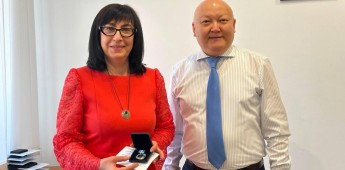
День металлурга в Национальном Центре по комплексной переработке минерального сырья Республики Казахстан
Materials on the submission for the assignment of the academic title of associate professor: Alimzhanova A.M.
Казахстанские ученые представили разработки в области полупроводниковых материалов на международной конференции RCCT-2026