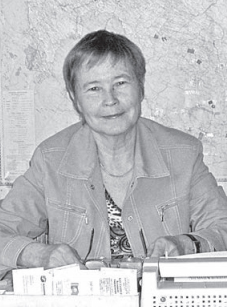
In professional circles, Lyudmila Sergeevna Bolotova, Candidate of Chemical Sciences, is called "our golden woman." She has been working with gold for about fifty years, and perhaps no one in our country knows more about precious metals.
Lyudmila Sergeevna has been heading the laboratory of precious metals of the Kazmehanobr State Scientific and Production Association of Industrial Ecology for 32 years. Moreover, it can be said that all the scientific activities of the laboratory and its head are a vivid example of the commercialization of developments. This is not the case when the works of scientists are gathering dust on the shelves.
The awarding of the Al-Farabi State Prize of the Republic of Kazakhstan in the field of science and technology was a well-deserved appreciation of the work of the scientific team led by the Director General of the National Center for Integrated Processing of Mineral Raw Materials of the Republic of Kazakhstan, Doctor of Technical Sciences, Professor, Academician of the National Academy of Sciences of the Republic of Kazakhstan Abdurasul Zharmenov, in which our heroine plays not the last violin. "Industrial implementation of developments in the field of lead and gold metallurgy, which have made a significant contribution to the innovative development of the country and raised the prestige of Kazakhstan in the global technology market" – this is how the long-term work of scientists was briefly presented in the official document.
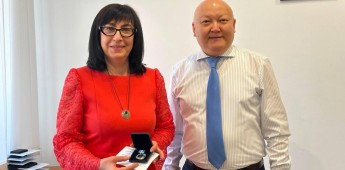
– The State Prize is an assessment of your work by the state, by the country, and the feelings you feel at the same time are difficult to convey, admits Lyudmila Sergeevna. – I remember the award ceremony – it was a very solemn and exciting moment. The recognition of professionals and colleagues is pleasant, but in your heart you always expect the assessment of the state. She is particularly proud of...
When the President presented her with the award, Lyudmila Bolotova said: "I will keep the warmth of your hands in my heart."
"I really love my job," Lyudmila Sergeevna continues. – With our team, we have tested about 500 types of ores. And there wasn't a single ore that had the same composition as the other. It is necessary to find a special approach to each ore in order to develop the only technology that will be simple, economical and give good results. And if everything is done carelessly, then the technology will remain on the shelf useless to anyone. Each ore has its own modes and indicators. According to Lyudmila Sergeevna, even before the Great Patriotic War, all the easily enriched ores in the USSR were processed. Before independence, the gold industry in Kazakhstan remained in the shadows, as the deposits were smaller, with a lower gold content in the ore. In the early 90s, due to lack of funds, enterprises in Kazakhstan stopped. During this difficult period, technologies that would be economically beneficial were needed.
The scientist recalls that then they took one of the most profitable paths. Based on the technology of heap leaching, we applied our own developments in ion exchange. The result was a low-cost technology, which was used to build and launch gold processing plants at the dawn of independence. The first gold from the Zhanan deposit was delivered to the refinery for 287 cu. per ounce. Now, a number of mines and enterprises have already exhausted their resources, producing gold using technology that has ensured its growth by 10 tons per year. It is no coincidence that the Stepnogorsk plant, which used this technology, was admired by foreign specialists.
Now modern gold mining factories have been built and are operating in the country – Akbakayskaya, Pustynaya, it is planned to launch new enterprises, the technological regulations for which have also been developed by the laboratory under the leadership of L. Bolotova.
"The task of technologists is to develop a technology in which the cost of gold will be justified, the company will make a profit, and the country will be a strategic metal," the specialist notes.
Every year the process of gold mining becomes more and more difficult. Therefore, the task of finding the easiest and economically feasible way to extract it from ore is always relevant for technologists. During the construction of factories, all possible technologies are considered, the most acceptable methods are checked by the nature of the ore, and all modes are being developed. Only after that, the design regulations are drawn up, taking into account all environmental requirements.
Looking back, she recalls that her first steps in studying gold began during her student internship in the assay analysis department of the chemical analytical laboratory of the Zyryanovsk lead Plant. And working with gold captured her from the very first days.
– I always wanted to learn something new, to experiment, - says L. Bolotova. – One day, together with the head of the colorimetric analysis department, we decided to develop a comprehensive methodology. As a result, we combined two types of analysis and developed several techniques.
In 1969, she successfully passed the competition for the position of senior researcher at the Kazmehanobra Laboratory of Precious Metals. Moving to Almaty was the fulfillment of her dream. In those years, scientific life was in full swing at the Research Institute, which captured her from the very first days. But she refused the offer to do a PhD, although she had accumulated more than enough material. "There came a time when I was known and appreciated in all enterprises of the country and without a title," explains Lyudmila Sergeevna. By the way, in the 70s and 80s of the last century, she worked as the curator of all gold factories in Uzbekistan.
But her native Kazmehanobr had to conquer the Kazakh market after gaining independence. Today, "Kazmehanobr" and Bolotova's surname are known in Kyrgyzstan, Canada, Australia, and China. Barrick Gold, the world's leading gold mining company, attracted her to introduce ion exchange gold extraction technology. When the Canadians saw the factory in Xinjiang, built according to the Kazmehanobra project, they immediately appreciated the advantages of the Kazakh technology. After three years of cooperation with our specialists, a similar factory has opened in Canada. And Lyudmila Sergeevna is pleased with the fact that today domestic investors predominate in the gold mining industry in Kazakhstan.
– Most enterprises of the mining and metallurgical industry for gold and copper extraction are associated with the laboratory of precious metals, - said Serikbol Shalgimbayev, winner of the Al-Farabi State Prize in Science and Technology, Director of Kazmehanobra. – The confidence in the results obtained in this laboratory is very high – this is how the team's work is set. The results of the work of laboratory scientists are always in demand by customers. Because they are innovative, highly productive, and applied. It is no coincidence that during the award ceremony, the Head of State noted that if we are talking about innovative Kazakhstan, we must understand that science plays a major role in this process.
Being a chemist by training, Lyudmila Bolotova notes its basic essence in all her works.
"Quite a lot of our developments have been implemented in Kazakhstan," she says. – But even today, years later, the fundamental knowledge that the luminaries of world chemical science have given us helps me. In my years, a whole galaxy of famous scientists taught at the Faculty of Chemistry of the Kirov State University. These are D. Sokolsky, M. Kozlovsky, M. Usanovich, B. Beremzhanov, O. Songina, A. Zebreva and others. When we studied at the Faculty of Chemistry of KazGU, it was the most fashionable specialty. Even the competition among the medalists was 7 people per place! Theory and practice went hand in hand, and we learned to work with both our hands and our heads.
Lyudmila Sergeevna is convinced that success comes to a person when he loves his job. Currently, 13 people work in the laboratory under her leadership. Of these, 5 are young professionals to whom senior colleagues try to impart not only knowledge, but dedication and love for their work. The team, and especially the young specialists, face serious tasks – to fulfill the President's order and involve not only the riches of the subsoil, but also the "second wealth" of Kazakhstan – dumps containing many valuable metals in the processing using new technologies.
Kazakhstanskaya Pravda newspaper, No. 43 (28169), March 4, 2016
Other news
ПРОТОКОЛ заседания конкурсной комиссии
День металлурга в Национальном Центре по комплексной переработке минерального сырья Республики Казахстан
Materials on the submission for the assignment of the academic title of associate professor: Alimzhanova A.M.
Казахстанские ученые представили разработки в области полупроводниковых материалов на международной конференции RCCT-2026