Every year, ten-digit amounts of products are produced worldwide using technologies for processing lead and gold-bearing raw materials, created by the National Center for Integrated Processing of Mineral Raw Materials of the Republic of Kazakhstan.
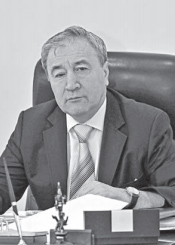
The technology operates in Asia and Europe, North and South America. Thanks to these works, Kazakhstan is one of the few countries selling its technologies, and domestic science in the field of lead and gold metallurgy occupies a leading position in the world. For these achievements, the center's team of scientists, led by the General Director of the RSE NC KPMS RK, Academician of the National Academy of Sciences of the Republic of Kazakhstan, Doctor of Technical Sciences, Professor Abdurasul Zharmenov, was awarded the 2015 Al-Farabi State Prize of Kazakhstan in the field of science and technology.
Our pride and calling card abroad is the upgraded high-tech technology, they talk about it at the center. At one time, the team of authors for KIVCET was already awarded the USSR State Prize in the field of science and technology. However, as one of its authors, academician Sultanbek Kozhakhmetov, emphasizes, the task of creating an effective technology for processing low–grade lead-containing raw materials of complex material composition remained unresolved.
"Therefore, we have significantly improved the process and the KIVCET melting unit," says Abdurasul Zharmenov, now twice a laureate of the State Prize of the Republic of Kazakhstan. – The upgraded KIVCET process is the most efficient for processing lead raw materials. Especially in conditions of deterioration of its quality. Our technology allows us to achieve high metal recovery – up to ninety-eight and a half percent from substandard raw materials. The specific productivity is almost doubled, and the operating costs are halved.
Over the past three years alone, the center's specialists have upgraded this technology at enterprises in Canada, Italy, and Bolivia, and built two new plants in China.
"China is trying not to buy technology, but it bought our lead by signing licensing agreements," continues A. Zharmenov. – The upgraded KIVCET process has been patented in 14 countries around the world, including Kazakhstan, Australia, Finland, Canada, the European Union, as well as China, Brazil, Mexico, India, and Russia. Four of them (Kazakhstan, Russia, China, Mexico) have received patents for the unit for its implementation. Today, every tenth ton of lead extracted from ore is produced using this technology in the world. I think this proves our leading position in the international market of lead production technologies.
The center's scientists, taking into account the government's need to increase gold production, are working in this direction. For the first time, they developed a technology for processing high-mineralized gold-bearing ores and concentrates. The presence of arsenic in the raw materials is a big problem. Arsenic interferes with the extraction of gold, and its removal is associated with environmental issues, as it forms toxic compounds.
–We have created a technology of oxidizing sulfidizing firing, which allows the removal of arsenic in the form of safe sulfide compounds," explains Academician Zharmenov. – These compounds are easy to store, transport and can be used as raw materials for the production of various arsenic-containing drugs. And most importantly, it makes it possible to extract the precious metal without hindrance.
The technology is protected by six pre-patents and patents of the Republic of Kazakhstan. It has been successfully tested at a number of Kazakhstani deposits – Bestyube, Bakyrchik, Sayak-4 – and implemented at the Nezhdaninsky ore processing plant of the Dzhugdzhurzoloto Mining Complex in Russia. The center's scientists have created breakthrough high-tech hydrometallurgical technologies that have no analogues in the world for processing hard-to-enrich gold-bearing mineral and man-made raw materials. Among these innovations is a highly efficient ion exchange technology for heap leaching of gold from poor gold–bearing ores, complex gold ores and man-made waste. Another know-how is the technology of sorption extraction of gold from cyanide pulps. As well as innovative technologies for desorption and electrolytic extraction of gold to produce marketable products – Dore alloy.
"We also developed equipment for carrying out processes, this solution allowed us to reduce capital costs for only one facility by more than a million dollars and operational costs by more than 300 thousand dollars compared to known desorption technologies," explains the scientist. – Dozens of gold mining enterprises in Kazakhstan, CIS countries and far abroad operate using our unique hydrometallurgical technologies. Thus, over the past ten years, more than 15 enterprises have been built and put into operation in Kazakhstan using the technology of heap leaching of oxidized ores, including in cooperation with the Canadian Saga Creek Gold Company. This made it possible to increase domestic gold production by more than ten tons per year. Using desorption and electrolytic gold extraction technologies, Dore plants have been built and are operating in Ust-Kamenogorsk, Semey and Stepnogorsk. They produce one and a half tons of gold per year each. And this list of enterprises both in Kazakhstan and in other countries of the world can be continued.
Other news
ПРОТОКОЛ заседания конкурсной комиссии

День металлурга в Национальном Центре по комплексной переработке минерального сырья Республики Казахстан
Materials on the submission for the assignment of the academic title of associate professor: Alimzhanova A.M.
Казахстанские ученые представили разработки в области полупроводниковых материалов на международной конференции RCCT-2026